We respect your privacy Landing Page
Edit Template Offline
2. Create new page and search for id 6543092
Edit Template Online
Create Awesome Websites


Free Nicepage Builder
Keywords
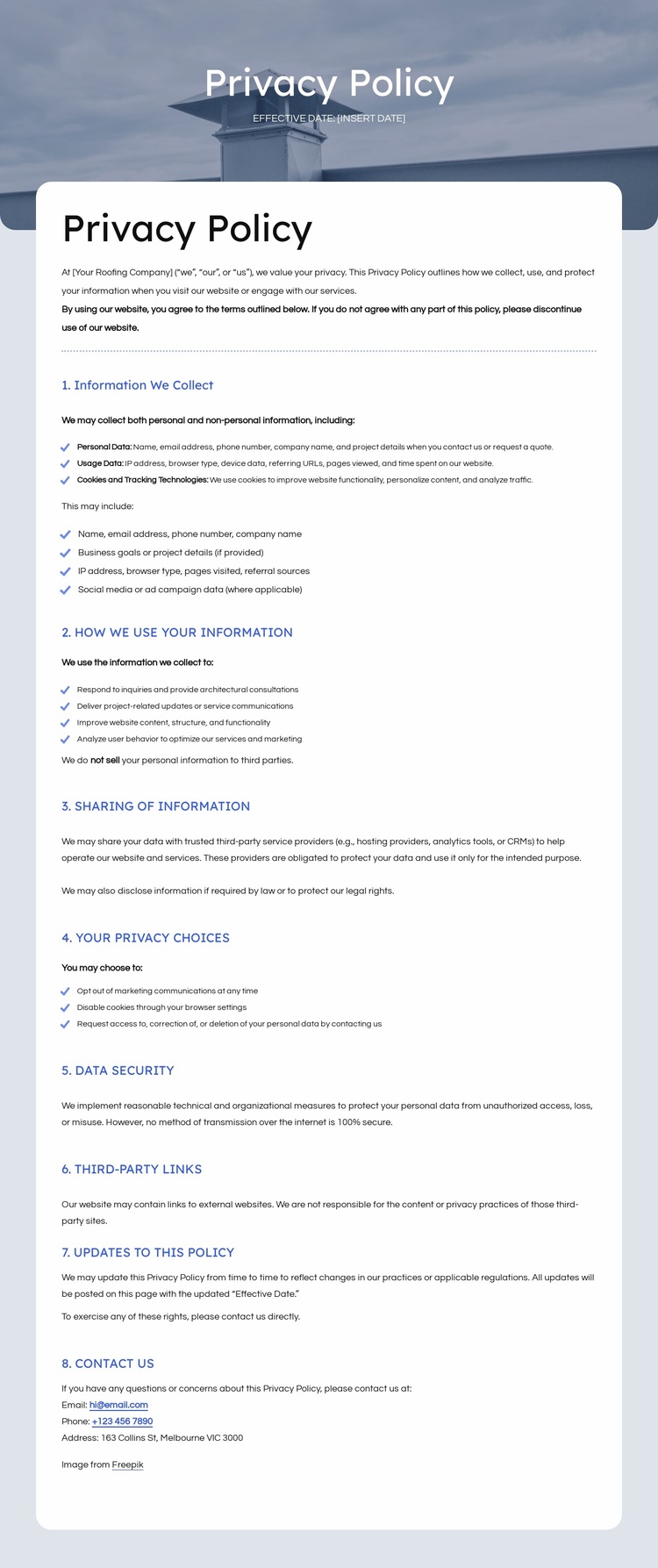
The Blue Banner Establishes Trust Before the Quote Action
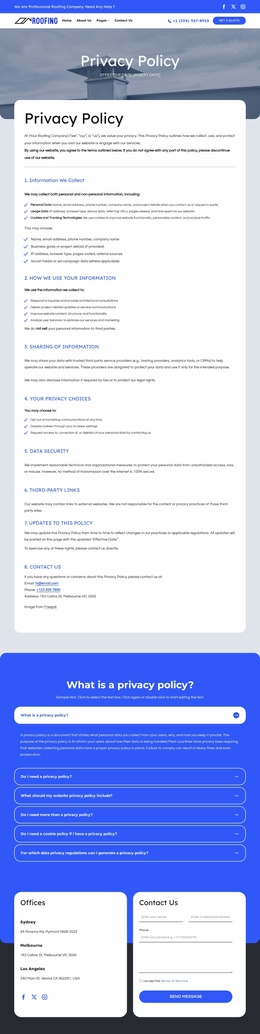
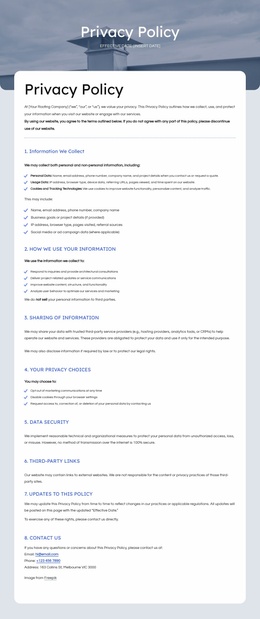
The page places the privacy document inside a broader contact path. The upper utility and navigation rows keep the roofing brand, social links, phone contact, and Get a quote action visible before visitors read the policy. That action is a verified part of the page, but the template does not establish a single campaign offer or a clearly isolated primary conversion goal. Its strongest landing-page interpretation is therefore a trust-supporting page that helps visitors understand information practices while preserving access to the wider inquiry path.
The blue title banner creates a clear transition into the Privacy Policy, and the dense light-gray content area provides the evidence a cautious visitor may need before contacting the company. It addresses personal data, usage data, cookies, information use, sharing with service providers or when required by law, marketing choices, cookie controls, access or deletion requests, security, external links, and policy updates. The final contact section supplies email, phone, and postal-address fields, giving the document a practical response point without inventing a separate form or offer.
The dark footer then returns visitors to company information and related destinations such as services, testimonials, and areas served. Used in a campaign flow, this page works best as a reassurance and policy step that supports a quote journey rather than replacing the main conversion page.
Customize with Nicepage
Open this ready-made template in the Landing Page Builder and customize it visually in the Nicepage editor. Replace demo content, edit page sections, and adapt the design to your project without rebuilding the template from scratch.
Build a Landing Page Around One Conversion Goal
Focus on One Primary Action
Use the landing page to guide visitors toward one measurable response, such as requesting a quote, registering, subscribing, booking a consultation, applying for a service, or submitting an inquiry. Keep the primary call-to-action consistent across the important sections so the headline, supporting content, form, and CTA buttons work toward the same campaign goal instead of competing for attention.
Capture Leads With a Form
Use the Contact Form Element to add a contact, subscription, application, or other conversion form directly to the landing page. Customize the form fields, layout, labels, inputs, and button to collect the information required for your campaign while keeping the form focused on the action you want visitors to complete.
Nicepage also provides several form submission options. Form submissions can be sent to Email, stored as Leads, added to Google Sheets, passed to a custom URL or server endpoint, or used to populate a MailChimp mailing list. This provides practical options for collecting inquiries, registrations, subscriptions, applications, and other campaign responses.
Manage Leads and Campaign Responses
When submissions are stored as Leads, you can use Contact Form Leads to review the information collected through the landing page and use it for follow-up. Keep the form connected to the same offer and primary CTA presented throughout the page so visitors move from the campaign message to a clear conversion action.
This workflow makes the template suitable for landing pages where the offer, content, call-to-action, form, and lead collection process work together toward one defined conversion goal.

Design Set (26)
-
Free Website Builder SoftwareDownload
-

-
-
-
-
-
-
-
-
-
-
-
-
-
-
-






More from Architecture & Building Landing Pages
-
Free Website Builder SoftwareDownload