Dark Fiction Author HTML Template


Edit Template Offline
2. Create new page and search for id 6661499
Edit Template Online
Create Awesome Websites


Free Nicepage Builder
Keywords
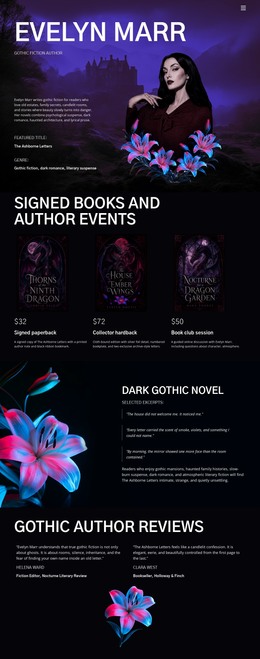
A portrait introduction and three book cards form a complete static presentation
The design already brings together the core content needed for a self-contained author page. The full-width portrait hero identifies Evelyn Marr and establishes the literary mood before the visitor reaches the three adjacent cards for signed-book offerings. Each card combines a cover image with a title, displayed price, and short description, creating a finished product-presentation area rather than a placeholder row that still needs its main content structure.
The following split section broadens the page beyond a simple catalog. A large floral image sits beside descriptive editorial copy and a highlighted excerpt for the dark gothic novel, giving the featured title a more immersive presentation. Author events are also represented as a distinct content area, while the closing review section adds three excerpts with reviewer labels and publication or source references. Together, these sections create a progression from author identity to offerings, featured reading material, event interest, and social proof.
That completeness makes the design suitable as a standalone static HTML implementation for a literary promotion page. The dark palette, condensed uppercase headings, and small editorial text keep the sections visually related, while the distinct card, split, and review arrangements prevent the page from feeling like a repeated content list. Its value lies in the finished combination of content areas, not merely in the atmospheric visual concept.
Customize with Nicepage
Open this ready-made template in the HTML Builder and customize it visually in the Nicepage editor. Replace demo content, edit page sections, and adapt the design to your project without rebuilding the template from scratch.
Export and Use This Template as an HTML Website
Create a Portable HTML Website
When the template is ready, use the HTML Export option to create a static website with the files required for deployment. The exported website can be used independently of the Nicepage editor and deployed on your preferred hosting.
Nicepage also provides SEO settings and optimization features, including Page Titles and Descriptions, Canonical settings, headings, image Alt Text, and other page-level properties that help prepare the website for search engines.
Deploy Without a CMS
Upload the finished website to the hosting environment that fits your project. Because the exported site does not require WordPress, Joomla, or another CMS to deliver its pages, it can be placed on your own server, uploaded to a hosting provider, or deployed through an existing web infrastructure.
Hand Off the Website Files
The generated website files can also be provided to a client, developer, or hosting team. They remain available outside the Nicepage editor for deployment, technical review, or project-specific development when additional work is required.
This workflow makes the template a practical foundation for a portable static website that can be exported from the Nicepage editor and deployed independently.

More from Music & Entertainment HTML Templates
-
Free Website Builder SoftwareDownload