Popular quizzes HTML Template


A Four-Topic Quiz Section Ready for Static HTML Pages
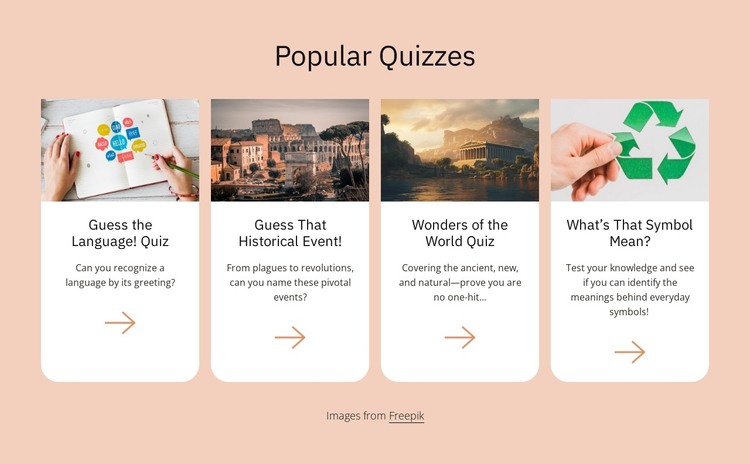
The heading and four repeated cards form a complete content unit for one quiz-library section. Each card carries a distinct topic—language, historical event, world wonder, or symbol—while retaining the same image, title, description, and arrow structure. That consistency makes the section understandable as soon as it is placed within a static HTML page, even though the surrounding page must provide any navigation, additional content, and broader document structure.
The single horizontal row gives the block a clear desktop presentation: four subjects are visible together rather than hidden behind a carousel or divided across separate sections. The full-width image at the top of each white rounded card establishes visual entry, and the centered dark text keeps the explanatory content aligned beneath it. Muted orange arrows add a repeated directional detail without introducing a confirmed interactive mechanism.
The soft peach background separates the quiz collection from neighboring content, while the generous whitespace prevents the four cards from reading as one dense text list. In a static HTML context, this ready-made arrangement can carry the quiz-library message as one reusable section. Other blocks can handle introductions, detailed quiz content, forms, or later educational material around it.
Customize with Nicepage
Open this ready-made template in the HTML Builder and customize it visually in the Nicepage editor. Replace demo content, edit page sections, and adapt the design to your project without rebuilding the template from scratch.
Edit Template Offline
2. Create a new page or select existing
3. Click Add new block, search for id 6533121 and click enter
Edit Template Online
Create Awesome Websites


Free Nicepage Builder
Keywords
Export and Use This Template as an HTML Website
Create a Portable HTML Website
When the template is ready, use the HTML Export option to create a static website with the files required for deployment. The exported website can be used independently of the Nicepage editor and deployed on your preferred hosting.
Nicepage also provides SEO settings and optimization features, including Page Titles and Descriptions, Canonical settings, headings, image Alt Text, and other page-level properties that help prepare the website for search engines.
Deploy Without a CMS
Upload the finished website to the hosting environment that fits your project. Because the exported site does not require WordPress, Joomla, or another CMS to deliver its pages, it can be placed on your own server, uploaded to a hosting provider, or deployed through an existing web infrastructure.
Hand Off the Website Files
The generated website files can also be provided to a client, developer, or hosting team. They remain available outside the Nicepage editor for deployment, technical review, or project-specific development when additional work is required.
This workflow makes the template a practical foundation for a portable static website that can be exported from the Nicepage editor and deployed independently.




More from Education Blocks
-

-

-
-
-
-
-
-
-
-
-
Free Website Builder SoftwareDownload
-
-
-
-
-
-
-
-
-
-















More from Grid Repeater Blocks
-

-
-
-
-
-
-
-
-
-
-
Free Website Builder SoftwareDownload
-
-
-
-
-
-
-
-
-
-