Empowering Digital Growth HTML Template


Edit Template Offline
2. Create new page and search for id 6393004
Edit Template Online
Create Awesome Websites


Free Nicepage Builder
Keywords
A Project Story That Already Moves From Evidence to Collaboration
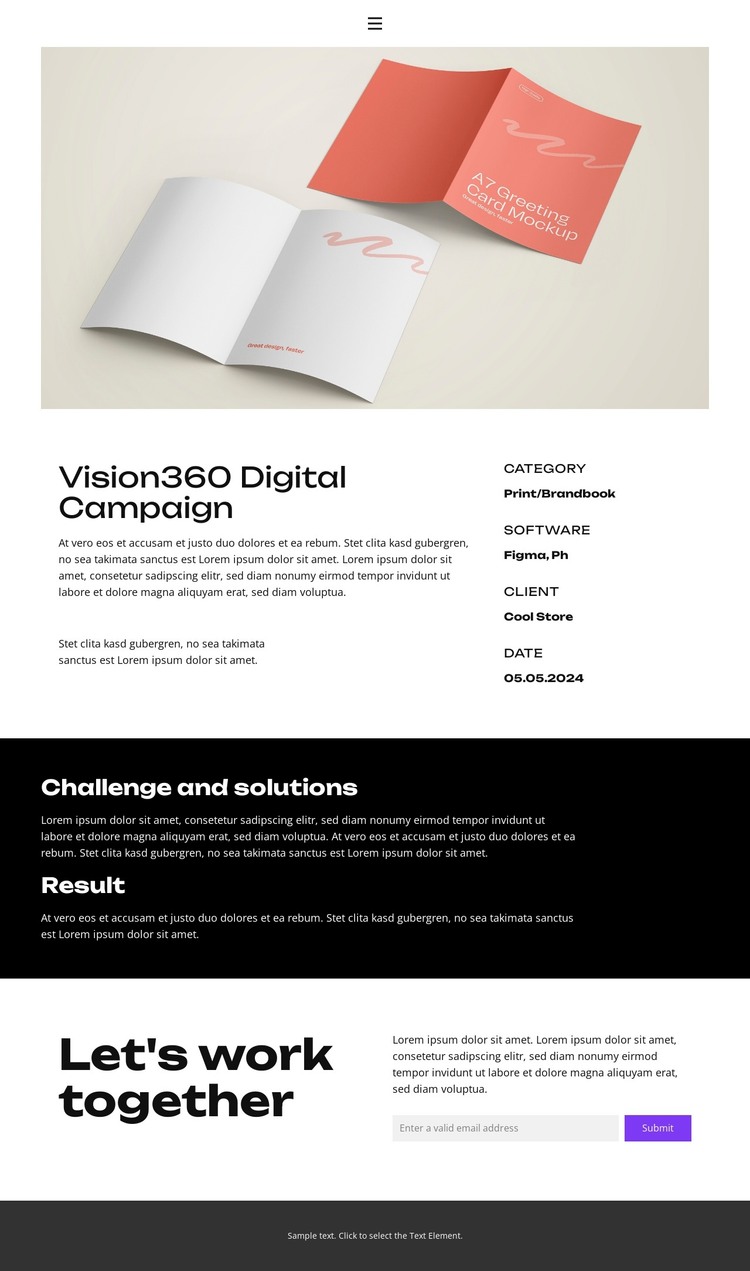
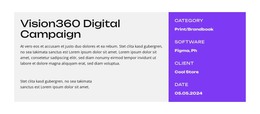
The large printed-materials image gives the static page an immediate visual subject, while the following split section supplies the context needed to understand the project. The descriptive column can introduce the work, and the adjacent metadata column identifies the Print/Brandbook category, Figma as the listed software, the client field, and the displayed date. Together, these areas make the page more than an image showcase: they form a finished project record with both visual evidence and reference information.
The dark Challenge and solutions section then changes the reading pace by placing the challenge narrative above the Result narrative. Even though the supplied text is placeholder content, the structure clearly supports a case-study explanation in a standalone HTML implementation. The closing collaboration block gives the page a practical endpoint, pairing “Let’s work together” with supporting copy and an email submission form. Navigation and mobile navigation keep the page connected to a wider portfolio context, while the dark footer provides a defined ending. This combination of image, metadata, narrative progression, and contact response makes the design usable as a complete static project page rather than only a visual mockup.
Customize with Nicepage
Open this ready-made template in the HTML Builder and customize it visually in the Nicepage editor. Replace demo content, edit page sections, and adapt the design to your project without rebuilding the template from scratch.
Export and Use This Template as an HTML Website
Create a Portable HTML Website
When the template is ready, use the HTML Export option to create a static website with the files required for deployment. The exported website can be used independently of the Nicepage editor and deployed on your preferred hosting.
Nicepage also provides SEO settings and optimization features, including Page Titles and Descriptions, Canonical settings, headings, image Alt Text, and other page-level properties that help prepare the website for search engines.
Deploy Without a CMS
Upload the finished website to the hosting environment that fits your project. Because the exported site does not require WordPress, Joomla, or another CMS to deliver its pages, it can be placed on your own server, uploaded to a hosting provider, or deployed through an existing web infrastructure.
Hand Off the Website Files
The generated website files can also be provided to a client, developer, or hosting team. They remain available outside the Nicepage editor for deployment, technical review, or project-specific development when additional work is required.
This workflow makes the template a practical foundation for a portable static website that can be exported from the Nicepage editor and deployed independently.

Design Set (13)
-

-
-
-
-
Free Website Builder SoftwareDownload
-
-
-



More from Art & Design HTML Templates
-
Free Website Builder SoftwareDownload