Expert legal solutions HTML Template


Edit Template Offline
2. Create new page and search for id 6307836
Edit Template Online
Create Awesome Websites


Free Nicepage Builder
Keywords
Services, Proof, and Inquiry Content Complete the Static Page
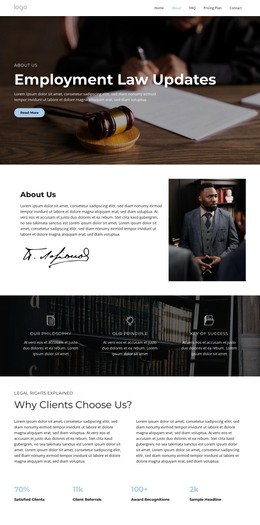
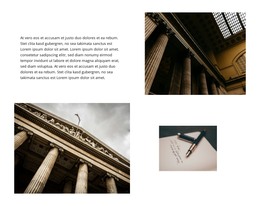
The finished arrangement covers the main content stages expected from this legal presentation without relying on a separate page to explain its central subject. The library hero establishes the advocacy message, while the following introduction and paired capability cards clarify the type of legal work being presented. Four compact capability items add a broader overview, and the three-person portrait area gives the page a visible team dimension without turning the layout into a dense directory.
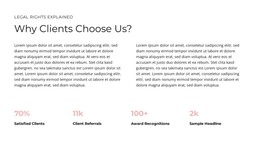
The service accordion keeps Civil Law, Criminal Defense, and Corporate Law together in one accessible content zone. After that, six meeting cards, partner marks, a testimonial, and a four-item counter strip create successive areas for recent content, association, client perspective, and structural proof. The sample figures and text are presentation content, so they should be replaced or verified before publication rather than treated as real firm results.
The final contact form and map provide a practical closing section, followed by contact information over a courthouse background and a dark footer. That sequence gives the design the characteristics of a standalone static legal page: a clear introduction, substantive service content, supporting proof, and a defined inquiry endpoint. Its visual completeness is useful even when the legal copy, images, and contact details are adapted for a different practice.
Customize with Nicepage
Open this ready-made template in the HTML Builder and customize it visually in the Nicepage editor. Replace demo content, edit page sections, and adapt the design to your project without rebuilding the template from scratch.
Export and Use This Template as an HTML Website
Create a Portable HTML Website
When the template is ready, use the HTML Export option to create a static website with the files required for deployment. The exported website can be used independently of the Nicepage editor and deployed on your preferred hosting.
Nicepage also provides SEO settings and optimization features, including Page Titles and Descriptions, Canonical settings, headings, image Alt Text, and other page-level properties that help prepare the website for search engines.
Deploy Without a CMS
Upload the finished website to the hosting environment that fits your project. Because the exported site does not require WordPress, Joomla, or another CMS to deliver its pages, it can be placed on your own server, uploaded to a hosting provider, or deployed through an existing web infrastructure.
Hand Off the Website Files
The generated website files can also be provided to a client, developer, or hosting team. They remain available outside the Nicepage editor for deployment, technical review, or project-specific development when additional work is required.
This workflow makes the template a practical foundation for a portable static website that can be exported from the Nicepage editor and deployed independently.

Design Set (12)
-

-
-
-
-
-
Free Website Builder SoftwareDownload
-
-




More from Business & Law HTML Templates
-
Free Website Builder SoftwareDownload