Agile software development HTML Template


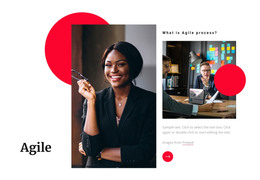
The Agile heading and image pairing form a prepared static content section
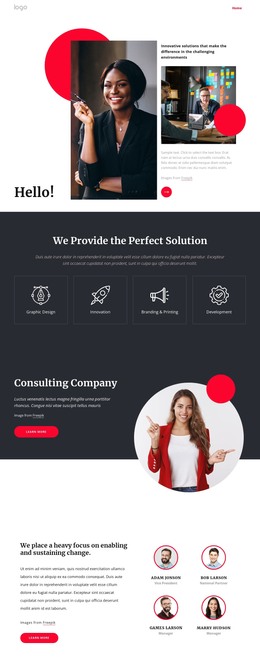
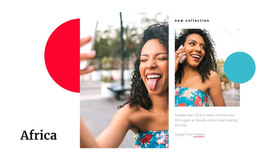
The section already brings together the main ingredients of an Agile introduction: a clear “Agile” heading, a direct question heading, explanatory paragraph content, and two business-oriented images. Its three-part horizontal arrangement gives each role a defined place. The title remains visually independent on the left, the large portrait carries the strongest image emphasis in the center, and the smaller meeting image supports the explanation on the right. Circular red accents add continuity without turning the block into a dense card layout.
Placed inside a static HTML page, this block can communicate one focused subject while surrounding sections provide navigation, additional process details, or contact content. The section is therefore useful as a self-contained informational unit, not as a complete page. The circular arrow control and image attribution remain part of the prepared arrangement, while the sample paragraph can be replaced with project-specific writing during implementation.
The visual hierarchy also makes the block straightforward to position between neighboring content areas. A preceding section could introduce a business context, while a later one could explain methods or outcomes in greater depth. Nicepage’s HTML Export supports exporting the containing project as a static HTML website, but the static implementation remains responsible for the broader page structure around this particular Agile section.
Customize with Nicepage
Open this ready-made template in the HTML Builder and customize it visually in the Nicepage editor. Replace demo content, edit page sections, and adapt the design to your project without rebuilding the template from scratch.
Edit Template Offline
2. Create a new page or select existing
3. Click Add new block, search for id 520538 and click enter
Edit Template Online
Create Awesome Websites


Free Nicepage Builder
Keywords
Export and Use This Template as an HTML Website
Create a Portable HTML Website
When the template is ready, use the HTML Export option to create a static website with the files required for deployment. The exported website can be used independently of the Nicepage editor and deployed on your preferred hosting.
Nicepage also provides SEO settings and optimization features, including Page Titles and Descriptions, Canonical settings, headings, image Alt Text, and other page-level properties that help prepare the website for search engines.
Deploy Without a CMS
Upload the finished website to the hosting environment that fits your project. Because the exported site does not require WordPress, Joomla, or another CMS to deliver its pages, it can be placed on your own server, uploaded to a hosting provider, or deployed through an existing web infrastructure.
Hand Off the Website Files
The generated website files can also be provided to a client, developer, or hosting team. They remain available outside the Nicepage editor for deployment, technical review, or project-specific development when additional work is required.
This workflow makes the template a practical foundation for a portable static website that can be exported from the Nicepage editor and deployed independently.

Design Set (19)
-

-
-
-
-
-
Free Website Builder SoftwareDownload
-
-
-
-
-
-
-
-
-












More from Business & Law Blocks
-
-
-
-
-
-
-
-
-
-
-
Free Website Builder SoftwareDownload
-
-
-
-
-
-
-
-
-
-










More from Shapes Blocks
-

-
-
-
-
-
-
-
-
-
-
Free Website Builder SoftwareDownload
-
-
-
-
-
-
-
-
-
-