We should be back shortly HTML Template


A Finished Static Section for Construction Updates
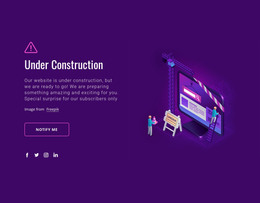
The image, announcement heading, supporting paragraph, and subscription controls already form a coherent temporary-update message. The centered construction image introduces the theme, the uppercase heading states the site status, and the paragraph provides context before the visitor reaches the email input and update button. That progression gives the section a complete communication role within its own content area, without requiring additional elements to explain the announcement itself.
Inside a static HTML page, the dark charcoal background and diagonal yellow-and-black caution stripes can act as a strong visual interruption between other page areas. The white centered typography keeps the message readable, while the horizontal form gives visitors a direct way to request future updates. Because the form is placed directly beneath the supporting copy, the response action remains easy to associate with the launch message.
The section can be inserted as one ready-made content area while surrounding static HTML supplies any broader navigation, introductions, or additional information. Its image credit link remains part of the arrangement and can be retained with the visual content. The result is a focused static section for a site that is preparing to launch and wants to collect update requests in the same visual frame.
Customize with Nicepage
Open this ready-made template in the HTML Builder and customize it visually in the Nicepage editor. Replace demo content, edit page sections, and adapt the design to your project without rebuilding the template from scratch.
Edit Template Offline
2. Create a new page or select existing
3. Click Add new block, search for id 307565 and click enter
Edit Template Online
Create Awesome Websites


Free Nicepage Builder
Keywords
Use This Block in a Static HTML Page
Start With a Ready-Made Section
A block provides one prepared content area that can be combined with other sections to build a static HTML page. Customize its text, images, spacing, colors, and other elements in the Nicepage editor while keeping the block focused on its own purpose, such as services, testimonials, pricing, contact information, or visual presentation.
Export the Containing HTML Project
When the page or website that contains the block is ready, use HTML Export to create the files required for a static HTML project. The export applies to the containing page/site rather than turning one individual block into a complete website by itself.
Reuse the Section Within the Project
The same block design can be adapted as one content section within a larger static site. Other Blocks can provide navigation, introductions, portfolios, forms, footers, and additional page content while this section keeps its own verified content and layout role.
This workflow makes the block useful as a ready-made section inside a static HTML implementation, with export and deployment handled at the page or website level.