We create amazing websites HTML Template
Edit Template Offline
2. Create new page and search for id 23732
Edit Template Online
Create Awesome Websites


Free Nicepage Builder
Keywords
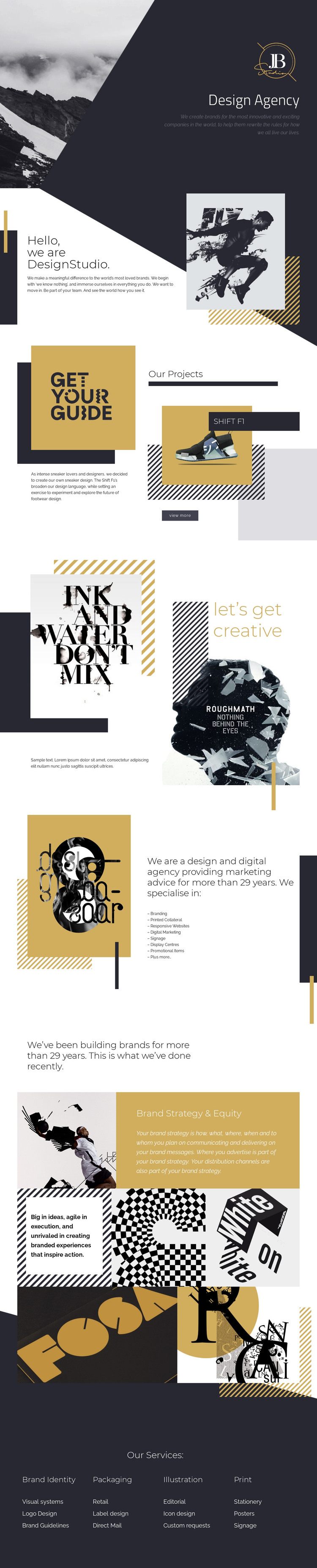
SHIFT F1 and Four Service Categories Form a Complete Static Presentation
The opening Design Agency block establishes the page’s subject immediately through a right-aligned statement over a dark geometric composition, with mountain imagery occupying the opposing visual area. The About Us section then adds agency context through a two-column arrangement that pairs introductory copy with layered imagery. Together, these sections give a static HTML implementation a clear beginning: identity first, approach second.
The content becomes more specific in the Our Projects section, where SHIFT F1 is presented as a featured project with supporting description and a view-more action. A later Brand Strategy & Equity section broadens that project-led presentation into a portfolio collage, while the creative interlude keeps the long page visually varied rather than turning it into a continuous service list. These relationships provide both narrative context and visual proof within one finished page arrangement.
The closing service structure adds practical coverage. Brand Identity, Packaging, Illustration, and Print appear as four peer categories, each supported by three named offerings such as Logo Design, Brand Guidelines, Retail, Label design, Editorial, Icon design, Stationery, and Posters. That combination makes the design usable as a standalone static agency page: it explains who the organization is, shows selected work, and defines its capabilities without requiring the core content architecture to be rebuilt.
Customize with Nicepage
Open this ready-made template in the HTML Builder and customize it visually in the Nicepage editor. Replace demo content, edit page sections, and adapt the design to your project without rebuilding the template from scratch.
Export and Use This Template as an HTML Website
Create a Portable HTML Website
When the template is ready, use the HTML Export option to create a static website with the files required for deployment. The exported website can be used independently of the Nicepage editor and deployed on your preferred hosting.
Nicepage also provides SEO settings and optimization features, including Page Titles and Descriptions, Canonical settings, headings, image Alt Text, and other page-level properties that help prepare the website for search engines.
Deploy Without a CMS
Upload the finished website to the hosting environment that fits your project. Because the exported site does not require WordPress, Joomla, or another CMS to deliver its pages, it can be placed on your own server, uploaded to a hosting provider, or deployed through an existing web infrastructure.
Hand Off the Website Files
The generated website files can also be provided to a client, developer, or hosting team. They remain available outside the Nicepage editor for deployment, technical review, or project-specific development when additional work is required.
This workflow makes the template a practical foundation for a portable static website that can be exported from the Nicepage editor and deployed independently.

More from Art & Design HTML Templates
-

-
Free Website Builder SoftwareDownload