Yachting HTML Template


A Two-Column Travel Introduction Ready for a Static HTML Page
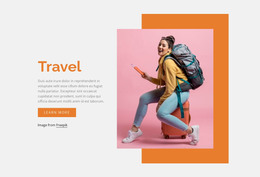
The left column already establishes the section’s editorial message through the “Travel company” label, the prominent heading, and supporting paragraphs. The right column complements that message with one travel image, another paragraph, and a “Learn more” button. Together, these regions form a self-contained introduction rather than a collection of unrelated text and media. The image gives the topic a visible focal point, while the button provides a next step without requiring the section to carry the surrounding page’s navigation or other content.
The warm orange rectangular accent behind the image adds a defined visual layer to the white background. Because the image overlaps that shape, the section has a recognizable arrangement that can remain intact when placed inside a static HTML page. Generous white space separates the text from the image and keeps the heading readable, while the two-column structure gives the block a clear horizontal rhythm.
For an HTML Template use case, this block can serve as one ready-made travel or destination-introduction section in a larger static page or site. The surrounding implementation can supply additional sections, while this block retains its own label, heading, paragraphs, image relationship, and “Learn more” action.
Customize with Nicepage
Open this ready-made template in the HTML Builder and customize it visually in the Nicepage editor. Replace demo content, edit page sections, and adapt the design to your project without rebuilding the template from scratch.
Edit Template Offline
2. Create a new page or select existing
3. Click Add new block, search for id 1000985 and click enter
Edit Template Online
Create Awesome Websites


Free Nicepage Builder
Keywords
Export and Use This Template as an HTML Website
Create a Portable HTML Website
When the template is ready, use the HTML Export option to create a static website with the files required for deployment. The exported website can be used independently of the Nicepage editor and deployed on your preferred hosting.
Nicepage also provides SEO settings and optimization features, including Page Titles and Descriptions, Canonical settings, headings, image Alt Text, and other page-level properties that help prepare the website for search engines.
Deploy Without a CMS
Upload the finished website to the hosting environment that fits your project. Because the exported site does not require WordPress, Joomla, or another CMS to deliver its pages, it can be placed on your own server, uploaded to a hosting provider, or deployed through an existing web infrastructure.
Hand Off the Website Files
The generated website files can also be provided to a client, developer, or hosting team. They remain available outside the Nicepage editor for deployment, technical review, or project-specific development when additional work is required.
This workflow makes the template a practical foundation for a portable static website that can be exported from the Nicepage editor and deployed independently.

More from Travel & Hotels Blocks
-
-

-
-
-
-
-
-
-
-
-
Free Website Builder SoftwareDownload
-
-
-
-
-
-
-
-
-
-





More from Shapes Blocks
-

-
-
-
-
-
-
-
-
-
-
Free Website Builder SoftwareDownload
-
-
-
-
-
-
-
-
-
-