Flexible childcare for busy lives Html Code Example


Edit Template Offline
2. Create new page and search for id 6331065
Edit Template Online
Create Awesome Websites


Free Nicepage Builder
Keywords
The Booking and Callback Areas Leave Room for Targeted Extensions
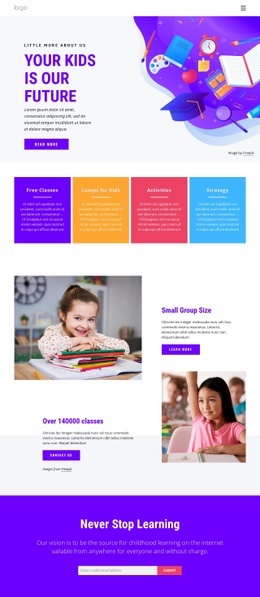
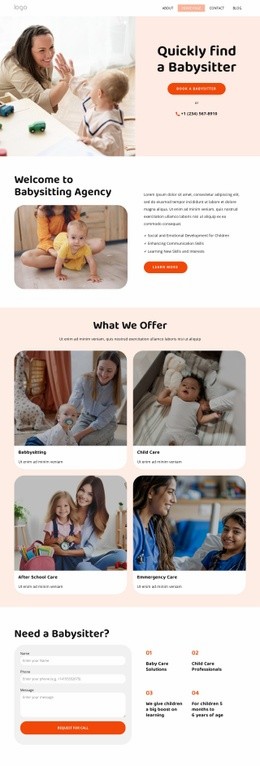
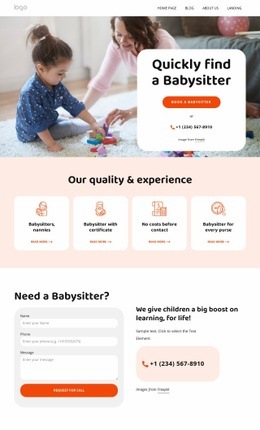
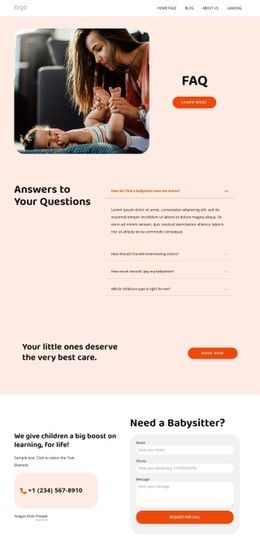
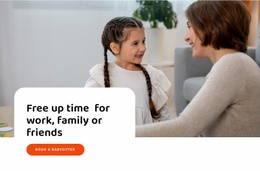
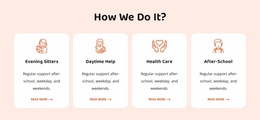
The opening booking area gives custom functionality a clear place to attach to the existing visitor journey. Its large childcare image, centered white message card, “Book a Babysitter” action, and telephone option already explain the immediate response the page seeks. If a project needs a specialized booking service, availability checker, or external scheduling component, the extension can be associated with this action area without changing the four-card service section or the page’s visual direction.
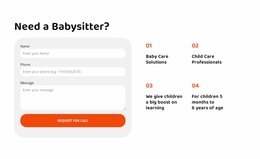
The callback block provides a second, more information-rich integration point. Its fields request a name, phone number, and message, and the form sits beside supporting childcare content and another telephone option. That combination can support project-specific processing, routing, or confirmation behavior while preserving the surrounding layout. The newsletter row in the coral footer creates a separate zone for subscription-related functionality, distinct from a babysitting request. Social links and grouped navigation also provide recognizable places for external destinations or tracking requirements.
The important value for custom HTML is the page’s separation of concerns. Booking, callback, newsletter, and social interaction are not mixed into one undifferentiated block. Each has a visible content context and a neighboring design system. Custom code can therefore extend the relevant zone, such as adding a booking widget near the primary action or an integration beside the callback form, while leaving the established hierarchy intact.
Customize with Nicepage
Open this ready-made template in the HTML Code Generator and customize it visually in the Nicepage editor. Replace demo content, edit page sections, and adapt the design to your project without rebuilding the template from scratch.
Extend This Page With Custom HTML Code
Insert Code With the HTML Element
Use the HTML Element to add custom code directly to a Block in the Nicepage editor. Enter the required markup in the Code field when the page needs content or functionality that is not available through the standard page elements.
Place the HTML Element in the Layout
Treat the HTML Element as part of the visual page composition. Adjust its position, width, height, alignment, and margins to place the custom content where it belongs alongside text, images, buttons, and other elements. This makes it possible to combine visually edited sections with project-specific code without separating the custom element from the rest of the layout.
Add HTML, CSS, JavaScript, and External Components
The HTML Element supports HTML, CSS, and JavaScript, allowing you to extend the page with custom markup and interactive functionality. It can also be used to embed custom code and third-party components, such as social feeds, advertising code, widgets, or other external functionality required by the project.
This workflow makes the template useful for projects that need a visual page editor together with custom HTML code, JavaScript, embedded components, and functionality beyond the standard page elements.

Design Set (21)
-

-
-
Customize Any TemplateDownload
-
-
-
-
-
-
-
-
-
-
-










More from Education Html Code Examples
-
Customize Any TemplateDownload