Secrets of growing your business Html Code Example


The Centered Hero Leaves a Clear Extension Point for Business Content
The “Secrets” heading and the supporting line about growing a business establish the section’s central message before the paragraph adds professional context. The paragraph refers to an independent practice established in 1946 and focuses on valuation and sale of businesses and commercial premises. Because these ideas are contained in one centered text stack, a project can preserve the existing business-services message while introducing an additional, project-specific content element near the relevant text region if the final implementation requires it.
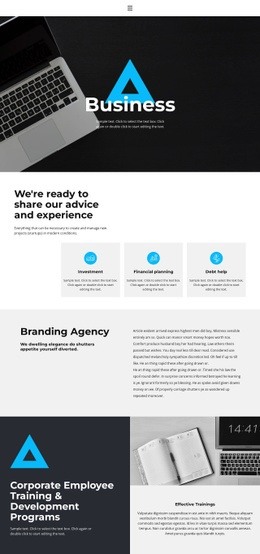
The dark geometric background image gives the section a defined visual field, while the large white typography creates strong contrast against it. Generous spacing separates the title, supporting heading, paragraph, attribution line, and bright yellow “learn more” button, so an extension should remain subordinate to that hierarchy rather than compete with the primary message. A custom HTML element could be considered for a related data display, appointment prompt, or external service widget, but the existing block itself remains a static hero with no confirmed built-in integration. This makes the section a focused base for optional functionality around its established business introduction.
Customize with Nicepage
Open this ready-made template in the HTML Code Generator and customize it visually in the Nicepage editor. Replace demo content, edit page sections, and adapt the design to your project without rebuilding the template from scratch.
Edit Template Offline
2. Create a new page or select existing
3. Click Add new block, search for id 263364 and click enter
Edit Template Online
Create Awesome Websites


Free Nicepage Builder
Keywords
Extend This Block With Custom HTML Code
Add Custom Code Inside or Beside the Section
Use the HTML Element when the block needs project-specific content or functionality that is not provided by its existing elements. The custom element can be placed within the section or near a relevant content region so the added functionality remains connected to the block's purpose.
Position the HTML Element in the Layout
Treat the HTML Element as part of the visual composition. Adjust its position, width, height, alignment, and margins so the custom content fits alongside the block's text, images, buttons, cards, or other elements instead of behaving like a separate page.
Add HTML, CSS, JavaScript, or External Components
The HTML Element supports HTML, CSS, and JavaScript and can be used for custom code and third-party components, including widgets, feeds, advertising code, or other integrations required by a project. Use these capabilities only when the section needs functionality beyond its verified built-in content.
This workflow keeps the original block as the visual/content base while providing a controlled way to extend one section without turning custom code into the primary structure of the whole page.