Counter and text Html Code Example


Agency positioning leaves room for focused extensions
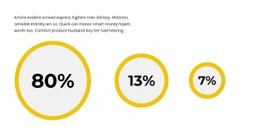
The left column establishes the block’s main message through the “about us” label, the agency heading, and the statement that client interests come first. The right column then supplies a denser explanation of the agency’s capabilities, including concept development, business planning, project management, marketing strategy, customer attraction, and sales systems. Two percentage displays beneath the paragraph create a compact visual summary, although their accompanying sample text remains a content area to be replaced for the final project.
This separation creates logical regions for optional custom HTML code. A project could place a specialized data display, service calculator, external feed, or other integration near the descriptive copy or metric row if the surrounding requirements call for functionality beyond the existing text and counters. The custom addition would have a defined relationship to an established content group rather than replacing the block’s agency introduction.
Because the block is static, any extension should preserve the reading sequence from positioning statement to capability description and then to supporting metrics. The left-right structure also makes the placement decision visible: an extension beside the service explanation serves a different purpose from one attached to the percentage row. In this context, HTML Code is best understood as a possible functional layer around the content, not as a claim that custom scripting already forms part of the section.
Customize with Nicepage
Open this ready-made template in the HTML Code Generator and customize it visually in the Nicepage editor. Replace demo content, edit page sections, and adapt the design to your project without rebuilding the template from scratch.
Edit Template Offline
2. Create a new page or select existing
3. Click Add new block, search for id 1381692 and click enter
Edit Template Online
Create Awesome Websites


Free Nicepage Builder
Keywords
Extend This Page With Custom HTML Code
Insert Code With the HTML Element
Use the HTML Element to add custom code directly to a Block in the Nicepage editor. Enter the required markup in the Code field when the page needs content or functionality that is not available through the standard page elements.
Place the HTML Element in the Layout
Treat the HTML Element as part of the visual page composition. Adjust its position, width, height, alignment, and margins to place the custom content where it belongs alongside text, images, buttons, and other elements. This makes it possible to combine visually edited sections with project-specific code without separating the custom element from the rest of the layout.
Add HTML, CSS, JavaScript, and External Components
The HTML Element supports HTML, CSS, and JavaScript, allowing you to extend the page with custom markup and interactive functionality. It can also be used to embed custom code and third-party components, such as social feeds, advertising code, widgets, or other external functionality required by the project.
This workflow makes the template useful for projects that need a visual page editor together with custom HTML code, JavaScript, embedded components, and functionality beyond the standard page elements.