AI Solutions HTML5 Template

Edit Template Offline
2. Create new page and search for id 6381030
Edit Template Online
Create Awesome Websites


Free Nicepage Builder
Keywords
The Hero-to-Subscription Hierarchy Keeps AI Content Inspectable
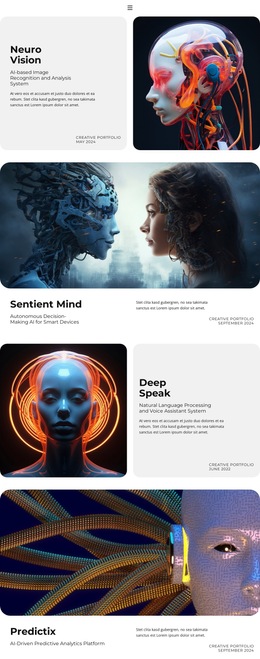
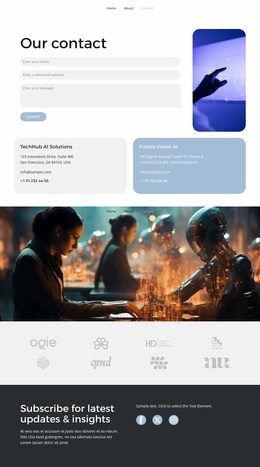
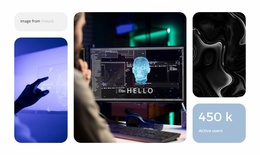
The page follows a distinct hierarchy from introduction to response. Its first split block combines the main AI headline, supporting copy, rounded image, Watch video action, and Learn more action, establishing the opening content group before the gallery begins. The gallery then forms a separate visual block, with one prominent virtual-reality image above three smaller rounded panels and a blue metric tile. A pale row of six subdued brand marks acts as its own association section rather than blending into the gallery.
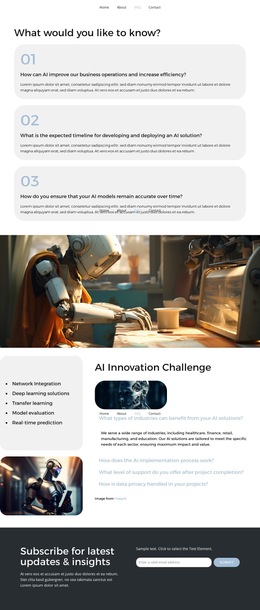
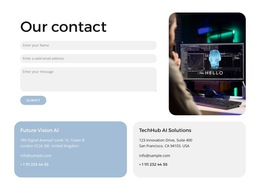
The middle of the page is similarly segmented. An About Us block pairs explanatory text and Read more with a futuristic portrait, followed by a dark Features band containing four solution columns. The Product List block changes the hierarchy again by stacking three named AI offerings with descriptions and action icons. A wide robotic image provides a clear transition to the Team block, where four portrait cards and a sample-content card form a repeated group. The final Contact Form block is identifiable as a subscription section through its heading, email input, and Subscribe button. This sequence makes the page organization easy to understand as an HTML5 layout of related but distinct content groups.
Customize with Nicepage
Open this ready-made template in the HTML5 Template Builder and customize it visually in the Nicepage editor. Replace demo content, edit page sections, and adapt the design to your project without rebuilding the template from scratch.
Explore This HTML5 Template Structure
Navigate the Page Structure
Customize this ready-made HTML5 template visually in the Nicepage editor while keeping its page organization easy to understand. Use the Layers panel to view the hierarchy of the Header, Blocks, Containers, Elements, and Footer, navigate between different parts of the page, and quickly select items within the layout.
The Layers panel also provides practical controls for working with more complex pages. Blocks, Containers, and Elements can be renamed for easier identification, temporarily hidden while editing, or locked to prevent accidental changes. The outline can also expose the internal structure of elements such as Menus and Contact Forms.
Work With Organized Page Sections
Blocks divide the page into major content sections, while Containers and Elements organize the content inside them. Keeping this hierarchy visible makes it easier to understand how individual parts of the page relate to one another, especially when a layout contains many nested elements.
You can use the Layers panel to move through this structure instead of selecting everything directly on the canvas, making complex layouts easier to inspect and manage as an organized page hierarchy.
Review and Extend the HTML
After customizing the page visually, the resulting HTML can be reviewed and adapted when code-level changes are required. If a project needs additional markup or functionality beyond the standard page elements, use the HTML Element to add targeted custom HTML where necessary.
This workflow combines visual editing with a clear view of the page hierarchy, making the template useful both as a ready-made design and as an HTML5 project whose structure can be inspected, managed, adapted, and extended.









More from Art & Design HTML5 Templates
-
Free Website Builder SoftwareDownload