Black and white gallery HTML5 Template


The Two-by-Two Image Group Leads Into Supporting Copy
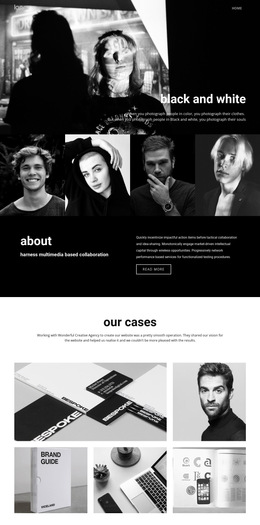
The internal organization begins with a gallery region containing four square photographic tiles. Their two-by-two arrangement creates a repeated image group with consistent item boundaries, while the lightbox behavior gives each tile an additional individual viewing relationship. Beneath that group, a separate centered paragraph provides supporting copy in a narrower, quieter layer. The order is straightforward: visitors encounter the image collection first, then the explanatory text that follows it.
This hierarchy makes the block readable as a set of related containers rather than a flat list of images and text. The four photographs share one visual role, and the paragraph has a different role that supports the collection without interrupting its grid. The monochrome portrait and nature imagery reinforces the unity of the repeated items, while the white background and generous margins preserve separation between the gallery region and the copy region. In an HTML5-oriented interpretation, the value lies in understanding these internal relationships: one repeated visual group, one supporting text group, and a lightbox interaction attached to the images. The block’s organization can therefore be maintained when individual content or styling details are adjusted inside the containing page.
Customize with Nicepage
Open this ready-made template in the HTML5 Template Builder and customize it visually in the Nicepage editor. Replace demo content, edit page sections, and adapt the design to your project without rebuilding the template from scratch.
Edit Template Offline
2. Create a new page or select existing
3. Click Add new block, search for id 1867717 and click enter
Edit Template Online
Create Awesome Websites


Free Nicepage Builder
Keywords
Explore the Structure of This HTML5 Block
Inspect the Block Hierarchy
Use the Layers panel to inspect the hierarchy of the block, including its Containers, Elements, repeated content groups, and nested items. For a reusable section, the useful structural question is how the content inside the block is organized, not how an entire website is arranged from Header to Footer.
Work With Organized Content Groups
A block can combine headings, text, images, buttons, grids, lists, forms, or other elements inside one structured section. Keeping those relationships visible makes it easier to select, rename, hide, lock, or reorganize parts of a more complex layout without losing the intended content hierarchy.
Extend the Structure Carefully
If a project later needs an extra content element or custom integration, the internal hierarchy can be inspected before changes are made. This helps preserve the relationship between the block's existing elements while the section is adapted to the needs of the containing page.
This workflow treats the design as an HTML5-oriented section with a clear internal organization, while page-level navigation, Header, Footer, and other site structure remain outside the block unless they are explicitly part of the section itself.