Graffiti as art CSS Template


Edit Template Offline
2. Create new page and search for id 24544
Edit Template Online
Create Awesome Websites


Free Nicepage Builder
Keywords
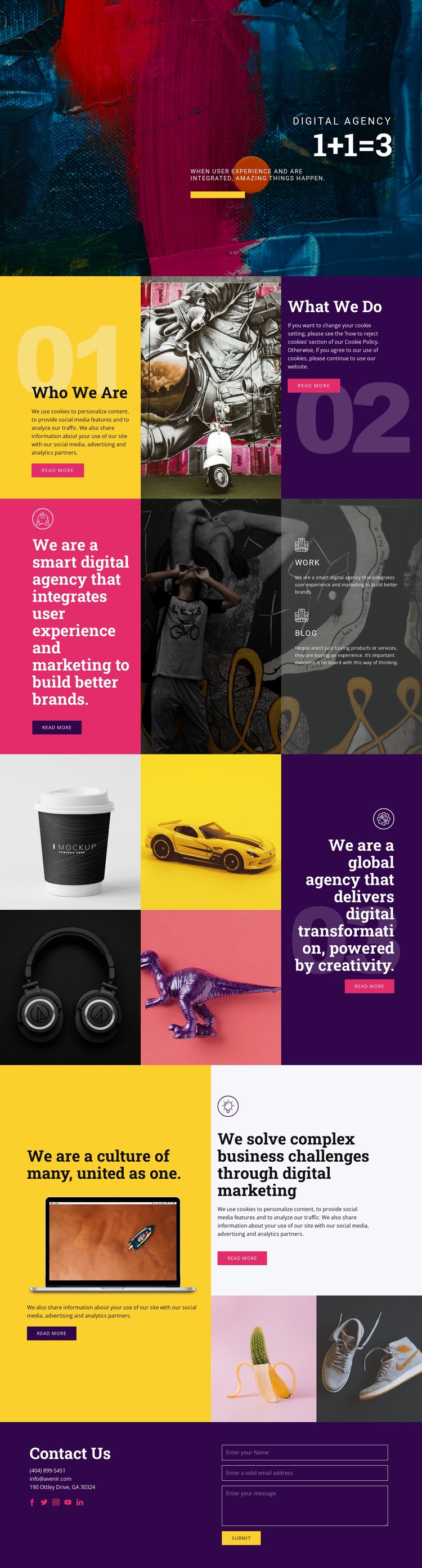
Yellow panels and photographic blocks define the styling system
The design’s visual identity comes from repeated color and type decisions rather than from a single decorative element. Yellow and magenta panels alternate with deep purple, black, and white areas, giving the three-panel introduction and the later culture section a recognizable styling rhythm. The full-width photographic hero uses a dark image behind small light copy and the oversized 1+1=3 statement, creating strong contrast between the background and the display text.
The same approach continues in the positioning and transformation sections. A magenta statement panel, monochrome or colorful photography, and a tall purple panel separate different content roles without losing visual connection. The four-image mosaic also introduces a repeated image-grid treatment, while the contact area uses a dark purple background and a bordered form to distinguish the final interaction from the editorial content above it.
As a CSS-oriented design, these recurring properties provide clear styling rules to preserve or adjust: high-contrast backgrounds, oversized typography, compact supporting copy, accent dividers, dense spacing, and sharply separated panels. Nicepage’s Custom CSS can extend those visual rules when the standard styling controls do not cover a project-specific treatment, but the template’s primary value is already visible in its coordinated colors, typography, backgrounds, borders, and image placement.
Customize with Nicepage
Open this ready-made template in the CSS Template Builder and customize it visually in the Nicepage editor. Replace demo content, edit page sections, and adapt the design to your project without rebuilding the template from scratch.
Customize This Template With CSS
Control Page-Specific Styling
Customize the visual appearance of this ready-made template directly in the Nicepage editor. Adjust typography, spacing, backgrounds, borders, colors, positioning, and other style properties using visual controls while keeping the page layout easy to manage without writing CSS manually.
Add Custom CSS When Needed
For styling requirements that go beyond the standard editor options, use Custom CSS to add targeted rules. CSS can be applied to individual elements, specific pages, or the entire website depending on the scope of the customization, while CSS classes can be used to connect custom rules with selected elements.
Export Minimal CSS Per Page
For projects where CSS size and page performance matter, Nicepage can export minimal CSS for each page. Instead of relying on one larger common stylesheet, each page can use a separate CSS file containing only the style rules required for that particular page. According to Nicepage documentation, these page-specific CSS files can be about ten times more compact, helping reduce unnecessary CSS and improve page loading performance.
This workflow combines visual styling with optional custom CSS and optimized page-specific CSS output, giving you additional control when a project requires it without making manual CSS editing the primary way to customize the template.