Reebok CSS Template
Edit Template Offline
2. Create new page and search for id 18116
Edit Template Online
Create Awesome Websites


Free Nicepage Builder
Keywords
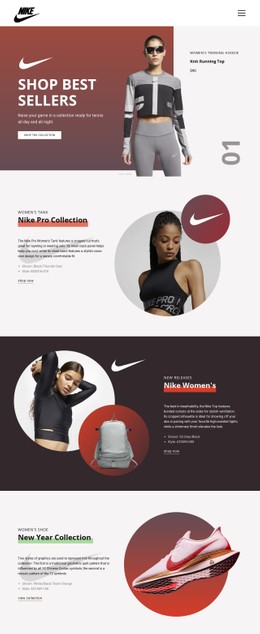
Black, White, and Red Styling Connects Products With Editorial Content
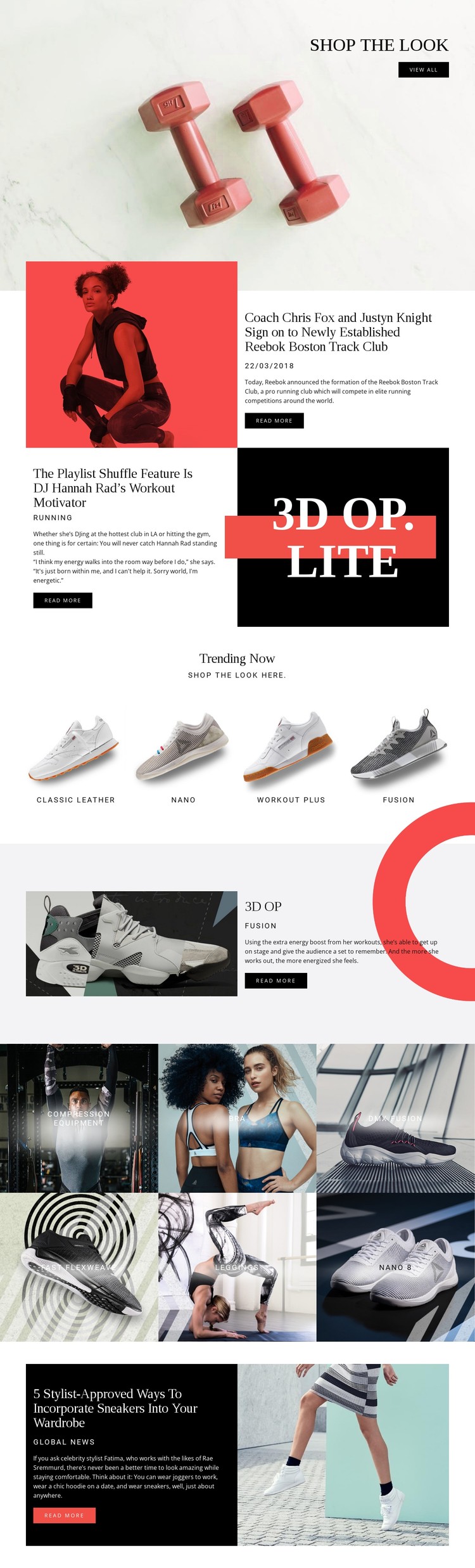
The page uses a clear visual styling system to separate and connect its different content roles. Large lifestyle images carry the opening “shop the look” area and the article features, while compact headings and short text panels keep the editorial material readable beside photography. Black and white provide the main contrast, and red accents draw attention to selected product graphics, labels, and action areas without changing the underlying section sequence.
The four-item Trending Now grid applies the same presentation logic to Classic Leather, nano, workout plus, and fusion. Each product tile receives comparable visual space, allowing the repeated labels and images to work as a consistent shopping pattern. The six-tile category gallery extends that rule into a denser two-row arrangement for compression equipment, bra, dmx fusion, fast flexweave, leggings, and nano 8. Split sections then interrupt the grid rhythm with larger image-and-text relationships, including the 3D OP feature and the closing sneaker wardrobe story.
For a CSS-oriented implementation, these repeated contrasts, spacing patterns, image proportions, and panel treatments form the page’s main style vocabulary. They can be refined independently while preserving the editorial-to-product progression.
Customize with Nicepage
Open this ready-made template in the CSS Template Builder and customize it visually in the Nicepage editor. Replace demo content, edit page sections, and adapt the design to your project without rebuilding the template from scratch.
Customize This Template With CSS
Control Page-Specific Styling
Customize the visual appearance of this ready-made template directly in the Nicepage editor. Adjust typography, spacing, backgrounds, borders, colors, positioning, and other style properties using visual controls while keeping the page layout easy to manage without writing CSS manually.
Add Custom CSS When Needed
For styling requirements that go beyond the standard editor options, use Custom CSS to add targeted rules. CSS can be applied to individual elements, specific pages, or the entire website depending on the scope of the customization, while CSS classes can be used to connect custom rules with selected elements.
Export Minimal CSS Per Page
For projects where CSS size and page performance matter, Nicepage can export minimal CSS for each page. Instead of relying on one larger common stylesheet, each page can use a separate CSS file containing only the style rules required for that particular page. According to Nicepage documentation, these page-specific CSS files can be about ten times more compact, helping reduce unnecessary CSS and improve page loading performance.
This workflow combines visual styling with optional custom CSS and optimized page-specific CSS output, giving you additional control when a project requires it without making manual CSS editing the primary way to customize the template.