Listening your favorite music Web Page Design
Edit Template Offline
2. Create new page and search for id 20021
Edit Template Online
Create Awesome Websites


Free Nicepage Builder
Keywords
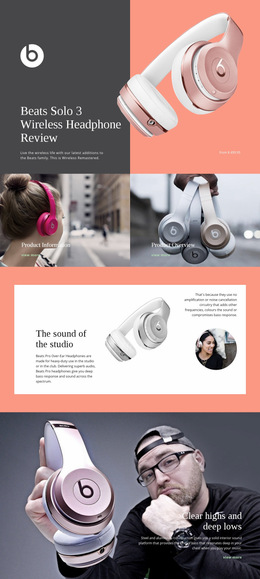
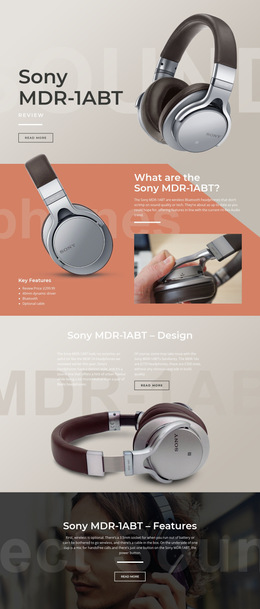
Alternating Image and Text Blocks Shape the Review’s Information Flow
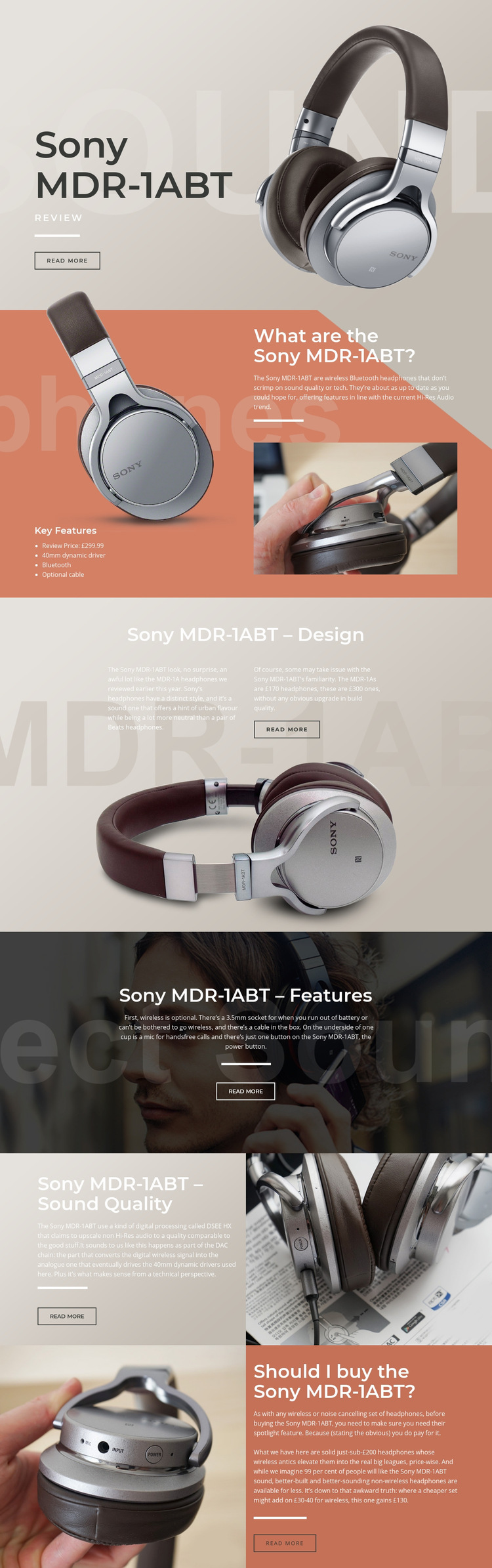
The page’s composition changes visual density as the review advances. The opening two-part hero places concise review copy beside a large headphone image, making the product recognizable before the reader meets detailed information. The overview then balances a feature image, explanatory text, and a four-item specification list, creating a compact information cluster around Bluetooth, the 40mm dynamic driver, optional cable, and the review price.
The next transition slows the presentation. The design section centers its heading above two text columns and a wide headphone image, allowing comparison with the MDR-1A to sit within a broader visual field. The following text-on-image block compresses practical information into a focused panel over a dark lifestyle photograph. Its discussion of wireless and wired use, the 3.5mm socket, cable, and hands-free microphone benefits from the stronger contrast and more concentrated layout.
A further split arrangement gives sound quality its own visual weight by placing DSEE HX and 40mm driver discussion beside a close-up image. Finally, the recommendation section balances product photography against a contrasting text panel, changing the page from explanation to purchase assessment. This sequence demonstrates page composition through placement, contrast, and transitions: images establish context, text columns provide analysis, and the closing panel gathers the evaluation. The design’s strength is therefore not merely the presence of sections, but how each arrangement changes the reader’s attention.
Customize with Nicepage
Open this ready-made template in the Web Page Design Builder and customize it visually in the Nicepage editor. Replace demo content, edit page sections, and adapt the design to your project without rebuilding the template from scratch.
Design a Web Page Section by Section
Choose a Design for Each Section
Build the page from individual content sections instead of starting with a fixed full-page layout. Use Block Designs to browse ready-made sections for different purposes, including introductions, services, galleries, testimonials, contact forms, pricing, and other common parts of a web page. Search or filter the available designs to find a layout that fits the content you want to add.
Combine Blocks and Page Elements
Add selected Blocks to the page and arrange them in the order that supports the page's purpose. A hero section can introduce the main message, followed by services, benefits, portfolio content, testimonials, calls to action, or contact information.
Inside each section, use Web Page Elements such as Text, Image, Hyperlink, Grid, Gallery, and other elements to build and present the page content. Individual elements can be added and adjusted within the Blocks, giving you more control over the composition of each section without having to create the complete layout from scratch.
Refine the Page Layout and Flow
After assembling the main sections, adjust their content, spacing, backgrounds, images, typography, and element placement in the Nicepage editor. Reorder Blocks when necessary and refine the transition from one section to the next so the information hierarchy and visual flow remain clear throughout the page.
This workflow makes the template useful as a web page design that can be composed from ready-made sections, customized with individual page elements, rearranged, and adapted to the content and purpose of an individual page.