Consulting case studies and stories One Page Template


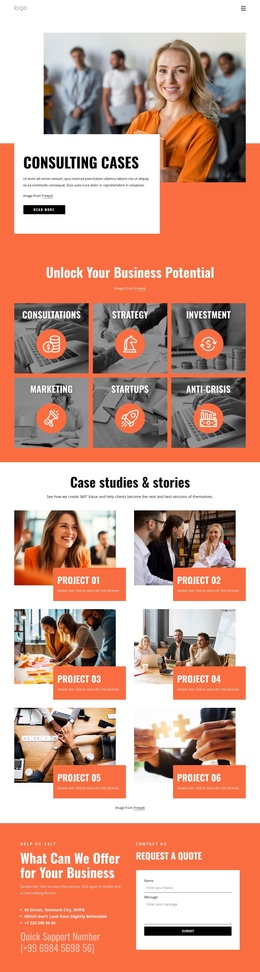
A Three-Row Project Grid Creates a Recognizable Page Destination
The centered heading and supporting description give this section a clear identity before the visitor reaches the six project entries. That identity is reinforced by the repeated structure: two cards per row, three rows in total, and the same relationship between a photographic image and an orange information panel overlapping its lower-right area. The result is a distinct case-study destination rather than an incidental group of images.
Within a continuous one-page experience, the section can provide a substantial portfolio or project-stories stop between introductory content and later information such as services, testimonials, or contact details. Project 01 through Project 06 make the sequence easy to distinguish, while the consistent panels help visitors understand that every item belongs to the same content category. The white background and generous vertical spacing also give the collection enough separation from neighboring sections.
The block does not need to become a separate page to carry this role. Its internal heading, explanatory copy, and six repeated entries already provide a complete content unit for the page journey. If the surrounding project uses section-based navigation, this block can serve as the visual destination for case studies while navigation and the rest of the continuous page remain outside it.
Customize with Nicepage
Open this ready-made template in the One Page Template Builder and customize it visually in the Nicepage editor. Replace demo content, edit page sections, and adapt the design to your project without rebuilding the template from scratch.
Edit Template Offline
2. Create a new page or select existing
3. Click Add new block, search for id 6224877 and click enter
Edit Template Online
Create Awesome Websites


Free Nicepage Builder
Keywords
Use This Block as a Section in a One-Page Website
Give the Block a Distinct Content Role
A one-page website combines several meaningful content sections within one continuous document. A block can serve as one of those destinations—for example About, Services, Gallery, Testimonials, Pricing, Team, or Contact—while other blocks provide the rest of the page journey.
Connect Navigation to Meaningful Sections
When the final page uses section-based navigation, Menu For One-Page Site can connect menu items to individual page Blocks. The analyzed block does not prove that anchor navigation already exists; it simply provides one possible destination when its content is substantial enough to stand as a recognizable section.
Keep Longer Pages Easy to Explore
For long one-page sites, Back To Top can help visitors return to the beginning after moving through several sections. Navigation behavior is managed at the page level, while each block retains its own content function.
This workflow positions the block as one part of a continuous one-page experience rather than treating a single section as the entire one-page site.