From elegant UI to seamless UX One Page Template


A Four-Column Portfolio Grid Creates a Distinct Page Destination
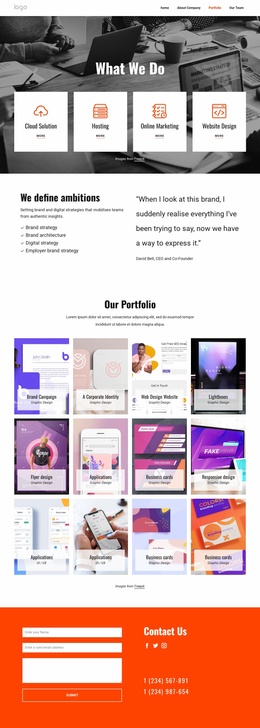
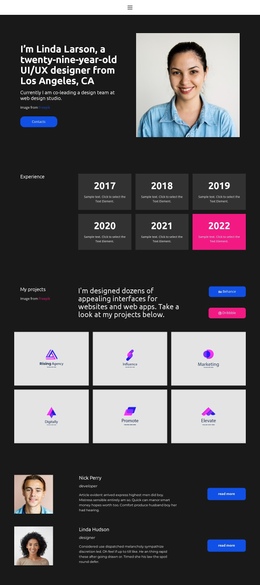
The centered “Our Portfolio” heading gives this section a clear identity within a continuous one-page experience. Its supporting paragraph introduces the collection, then the twelve repeated project tiles provide a substantial visual destination rather than a small decorative strip. Four columns across three rows make the portfolio area visibly distinct from surrounding sections, while the repeated portrait images give visitors a consistent way to scan the work.
Each tile carries its own project title and category label in a translucent light overlay near the lower edge. This lets the portfolio function as recognizable content even when the images vary in subject, including branding, editorial, application, and interface-related visuals. The category labels, such as Graphic Design and UI / UX, add a simple classification layer, while rounded corners and the white background help the section maintain its own visual boundary. The image credit line sits below the grid as a final supporting detail.
Within a one-page template, this block can act as the portfolio or work destination between introductory content and later information such as services, testimonials, or contact. It does not need to become a separate page to carry that role. If the surrounding page adds section navigation, this clearly bounded heading-and-grid arrangement gives that navigation a meaningful content target without claiming that navigation already exists in the block.
Customize with Nicepage
Open this ready-made template in the One Page Template Builder and customize it visually in the Nicepage editor. Replace demo content, edit page sections, and adapt the design to your project without rebuilding the template from scratch.
Edit Template Offline
2. Create a new page or select existing
3. Click Add new block, search for id 6058699 and click enter
Edit Template Online
Create Awesome Websites


Free Nicepage Builder
Keywords
Build a Navigable One-Page Website
Connect the Menu to Page Sections
Organize the website as a sequence of sections on a single page and use the Menu For One-Page Site to connect menu items with individual page Blocks. Visitors can jump directly to sections such as About, Services, Testimonials, or Contact without opening separate pages.
Keep the Website on One URL
A one-page template can combine several parts of a small website within one continuous page. Arrange the Header, introduction, services, portfolio, company information, reviews, contact details, and other relevant sections in the order that fits the project while keeping them accessible through the same page navigation.
Make Long Pages Easier to Navigate
For longer one-page websites, keep navigation labels short and connected to meaningful sections so visitors can move through the page without relying only on scrolling. You can also use the Back To Top element to provide a quick way back to the beginning after longer sections.
This workflow makes the template suitable for compact websites that need several distinct content sections while keeping the complete visitor experience on one URL.