Fast registration One Page Template


Edit Template Offline
2. Create new page and search for id 6037091
Edit Template Online
Create Awesome Websites


Free Nicepage Builder
Keywords
From “Our Contact” to Newsletter Signup in One Continuous Flow
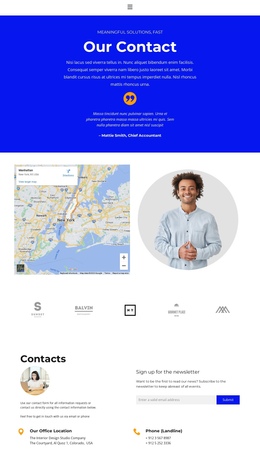
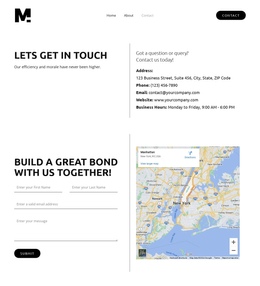
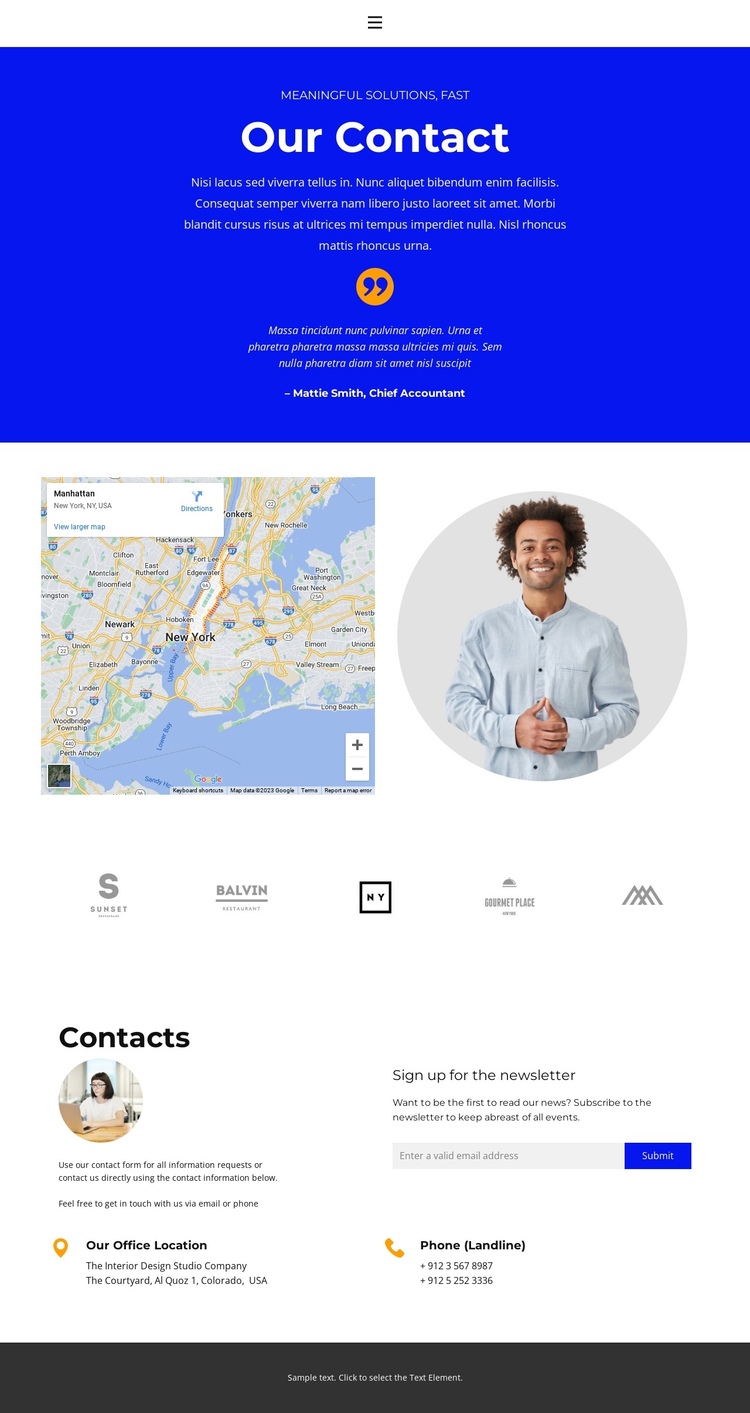
The page has enough distinct content zones to create a meaningful single-page journey. Visitors first encounter the horizontal navigation and its mobile control, then arrive at the cobalt-blue “Our Contact” section, where centered typography and a quoted statement establish the opening context. The map-and-portrait split follows as a separate visual destination, giving location and personal imagery their own place instead of placing them inside the introductory text.
The five repeated image marks form another recognizable group before the page reaches its most information-dense section. In the two-column contact area, newsletter messaging and the email signup form appear with office-location content and landline details. These relationships make the sections useful as separate destinations within one document: introduction, location, image strip, newsletter response, and direct contact information. The dark footer then marks the end of the continuous experience.
The design does not require a claim that anchor links already exist. Its verified section sequence is sufficient to support one-page organization, provided navigation labels are connected to the project’s chosen destinations during implementation. The result is a compact page that lets visitors move through several kinds of contact content without separating the introduction, location context, subscription request, and office details across multiple URLs.
Customize with Nicepage
Open this ready-made template in the One Page Template Builder and customize it visually in the Nicepage editor. Replace demo content, edit page sections, and adapt the design to your project without rebuilding the template from scratch.
Build a Navigable One-Page Website
Connect the Menu to Page Sections
Organize the website as a sequence of sections on a single page and use the Menu For One-Page Site to connect menu items with individual page Blocks. Visitors can jump directly to sections such as About, Services, Testimonials, or Contact without opening separate pages.
Keep the Website on One URL
A one-page template can combine several parts of a small website within one continuous page. Arrange the Header, introduction, services, portfolio, company information, reviews, contact details, and other relevant sections in the order that fits the project while keeping them accessible through the same page navigation.
Make Long Pages Easier to Navigate
For longer one-page websites, keep navigation labels short and connected to meaningful sections so visitors can move through the page without relying only on scrolling. You can also use the Back To Top element to provide a quick way back to the beginning after longer sections.
This workflow makes the template suitable for compact websites that need several distinct content sections while keeping the complete visitor experience on one URL.