Counter Synergy Design One Page Template


A Distinct Heading and Counter Row Create One Page Destination
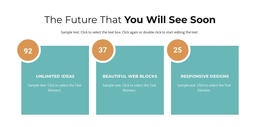
The section has enough internal definition to stand as a recognizable content destination within a continuous one-page experience. “Our Projects” marks the area, and “The Future That You Will See Soon” gives visitors a clear reason to identify it as a separate stage in the page journey. Beneath the headings, the three counter items repeat the same pattern of icon, large numeric value, label, and supporting paragraph. That repeated structure makes the destination easy to scan as one group of related highlights.
Its strongest one-page role is informational rather than action-led. The block can present project context, statistics, or future-oriented highlights between an introduction and later content such as services, proof, or contact information. The three columns keep the content compact, while generous spacing separates the heading from the row and gives the section a visible boundary. The static interaction model means visitors can read all three items in place instead of navigating hidden panels or slides.
This interpretation concerns the section’s place in continuous content flow, not an existing anchor system. If the containing page uses section-based navigation, the block’s heading and consistent content model can give that destination a meaningful identity. The block still remains one reusable section, with neighboring blocks supplying the rest of the page journey and broader information architecture.
Customize with Nicepage
Open this ready-made template in the One Page Template Builder and customize it visually in the Nicepage editor. Replace demo content, edit page sections, and adapt the design to your project without rebuilding the template from scratch.
Edit Template Offline
2. Create a new page or select existing
3. Click Add new block, search for id 41839 and click enter
Edit Template Online
Create Awesome Websites


Free Nicepage Builder
Keywords
Build a Navigable One-Page Website
Connect the Menu to Page Sections
Organize the website as a sequence of sections on a single page and use the Menu For One-Page Site to connect menu items with individual page Blocks. Visitors can jump directly to sections such as About, Services, Testimonials, or Contact without opening separate pages.
Keep the Website on One URL
A one-page template can combine several parts of a small website within one continuous page. Arrange the Header, introduction, services, portfolio, company information, reviews, contact details, and other relevant sections in the order that fits the project while keeping them accessible through the same page navigation.
Make Long Pages Easier to Navigate
For longer one-page websites, keep navigation labels short and connected to meaningful sections so visitors can move through the page without relying only on scrolling. You can also use the Back To Top element to provide a quick way back to the beginning after longer sections.
This workflow makes the template suitable for compact websites that need several distinct content sections while keeping the complete visitor experience on one URL.