Mustang One Page Template


Edit Template Offline
2. Create new page and search for id 24072
Edit Template Online
Create Awesome Websites


Free Nicepage Builder
Keywords
Six Mustang Sections Build a Continuous Editorial Journey
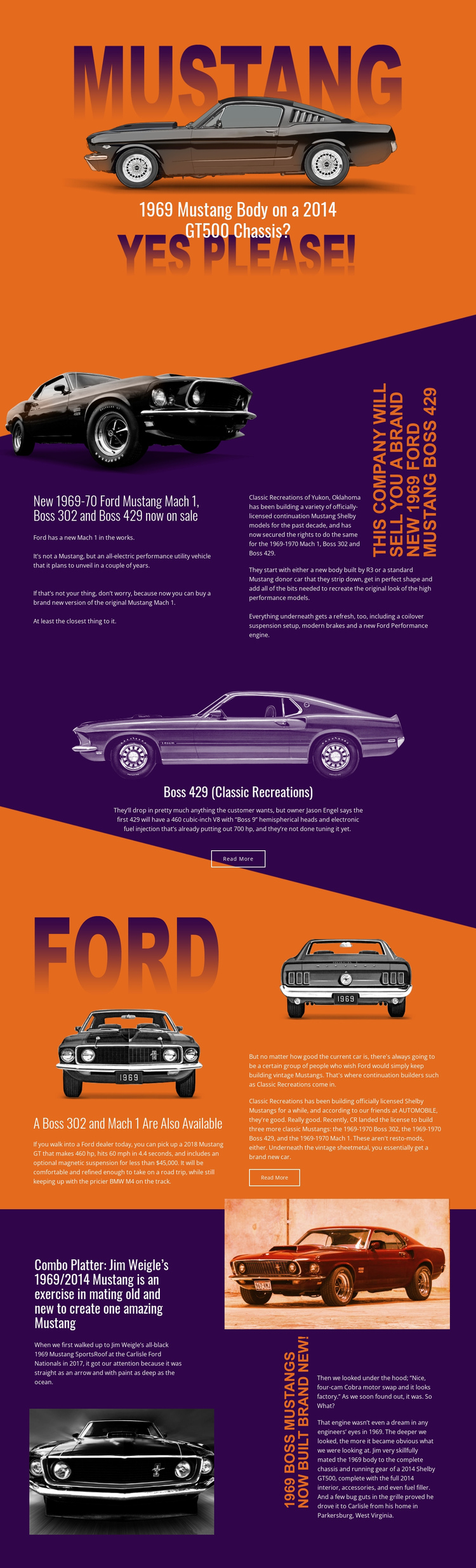
The page’s six-section order supports a one-page reading experience because each content group has a recognizable subject and visual boundary. The hero introduces the 1969-body and 2014-GT500-chassis idea, then the first split section expands into continuation versions of the Mach 1, Boss 302, and Boss 429. The centered Boss 429 panel works as a separate destination within that broader model coverage, using one large image and a focused article action.
The fourth section changes direction slightly by returning to the Boss 302 and Mach 1, while the fifth and sixth areas keep the attention on Jim Weigle’s custom 1969/2014 Mustang. This order lets visitors move from introduction to model overview, individual feature, additional coverage, and final custom-build narrative without leaving the document. The orange, dark purple, and image-led transitions help signal those changes as the visitor scrolls.
The Read More actions can serve as local continuation points inside the broader content sequence, but the page’s main strength is navigation through distinct stories rather than a single form-led response. If the design is adapted as a one-page site, its real sections can become meaningful destinations while preserving the editorial progression and the shared classic-Mustang subject.
Customize with Nicepage
Open this ready-made template in the One Page Template Builder and customize it visually in the Nicepage editor. Replace demo content, edit page sections, and adapt the design to your project without rebuilding the template from scratch.
Build a Navigable One-Page Website
Connect the Menu to Page Sections
Organize the website as a sequence of sections on a single page and use the Menu For One-Page Site to connect menu items with individual page Blocks. Visitors can jump directly to sections such as About, Services, Testimonials, or Contact without opening separate pages.
Keep the Website on One URL
A one-page template can combine several parts of a small website within one continuous page. Arrange the Header, introduction, services, portfolio, company information, reviews, contact details, and other relevant sections in the order that fits the project while keeping them accessible through the same page navigation.
Make Long Pages Easier to Navigate
For longer one-page websites, keep navigation labels short and connected to meaningful sections so visitors can move through the page without relying only on scrolling. You can also use the Back To Top element to provide a quick way back to the beginning after longer sections.
This workflow makes the template suitable for compact websites that need several distinct content sections while keeping the complete visitor experience on one URL.