World Cup One Page Template


Edit Template Offline
2. Create new page and search for id 14097
Edit Template Online
Create Awesome Websites


Free Nicepage Builder
Keywords
Eight Content Destinations on One Continuous Football Page
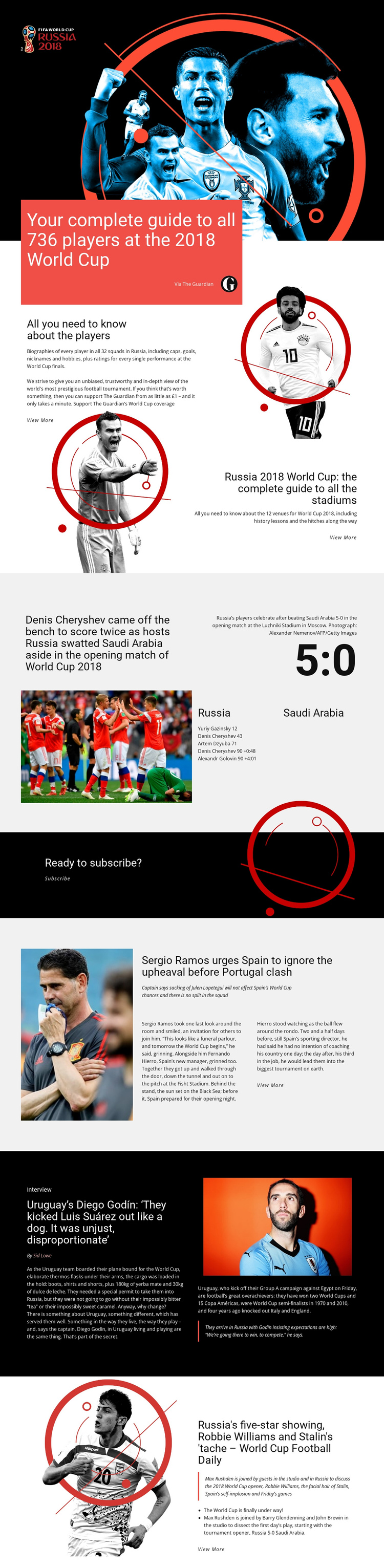
The design naturally divides into several meaningful destinations without requiring the subjects to be scattered across separate pages. The opening player guide introduces the tournament reference journey, followed by explanatory player content and a separate stadium guide for 12 venues. Those sections provide distinct reading stops: visitors can move from squad-level information to venue-level context while remaining within the same editorial flow.
The match-report grid forms another destination because its purpose differs from both guides. The Russia–Saudi Arabia 5:0 result, scorer details, match photograph, and Luzhniki Stadium caption create a compact news feature. The dark subscription block then works as a clearly marked pause in the sequence. It is followed by Spain and Portugal reporting, an interview-led Diego Godín section, and the Football Daily feature, each offering a different content type and visual rhythm.
This arrangement suits a one-page structure because the sections are substantial enough to be understood as separate stops, yet visually connected through the shared football palette and editorial typography. The repeated View More links can support movement into deeper material, while the Subscribe link marks the page’s response area. The design therefore offers multiple content destinations within one continuous document rather than reducing the experience to a single promotional message.
Customize with Nicepage
Open this ready-made template in the One Page Template Builder and customize it visually in the Nicepage editor. Replace demo content, edit page sections, and adapt the design to your project without rebuilding the template from scratch.
Build a Navigable One-Page Website
Connect the Menu to Page Sections
Organize the website as a sequence of sections on a single page and use the Menu For One-Page Site to connect menu items with individual page Blocks. Visitors can jump directly to sections such as About, Services, Testimonials, or Contact without opening separate pages.
Keep the Website on One URL
A one-page template can combine several parts of a small website within one continuous page. Arrange the Header, introduction, services, portfolio, company information, reviews, contact details, and other relevant sections in the order that fits the project while keeping them accessible through the same page navigation.
Make Long Pages Easier to Navigate
For longer one-page websites, keep navigation labels short and connected to meaningful sections so visitors can move through the page without relying only on scrolling. You can also use the Back To Top element to provide a quick way back to the beginning after longer sections.
This workflow makes the template suitable for compact websites that need several distinct content sections while keeping the complete visitor experience on one URL.