Fly Agency One Page Template


Edit Template Offline
2. Create new page and search for id 12820
Edit Template Online
Create Awesome Websites


Free Nicepage Builder
Keywords
From Onboard Amenities to Lounges, Each Section Becomes a Page Destination
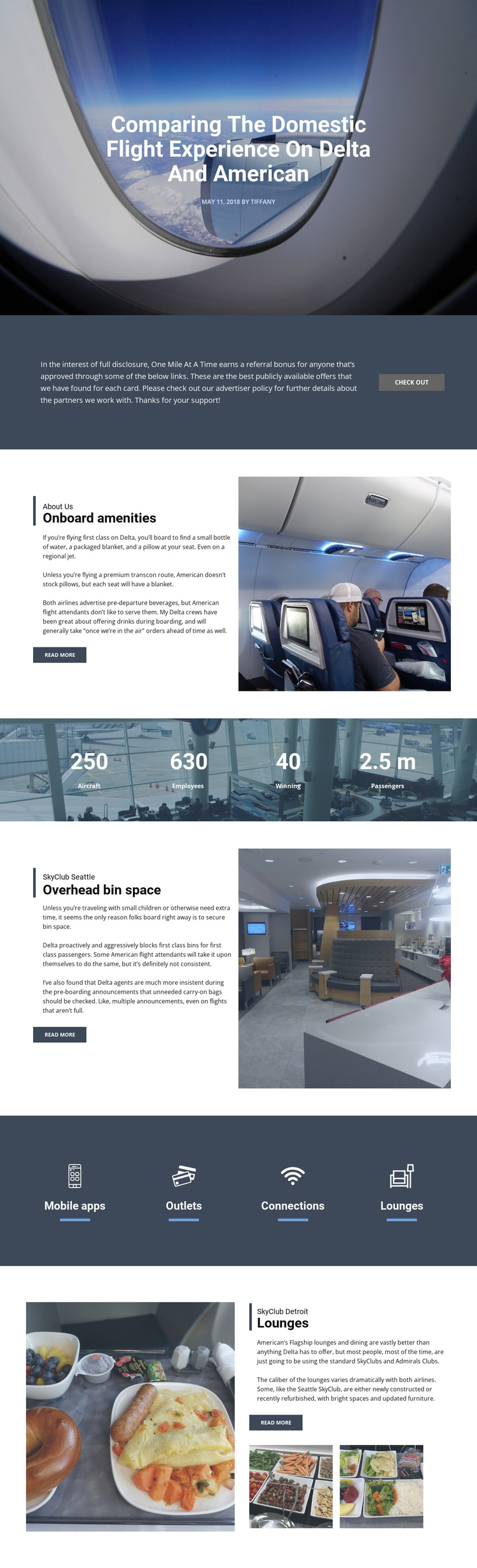
The design already has a natural sequence for a one-page visitor journey. The opening hero introduces the Delta-versus-American comparison, while the following dark disclosure band provides a separate contextual stop before the article details begin. The first split section can serve as the destination for onboard amenities, pairing the heading with comparison text and a cabin photograph. The next split section changes the subject to overhead bin space, giving visitors another clearly differentiated point in the same document.
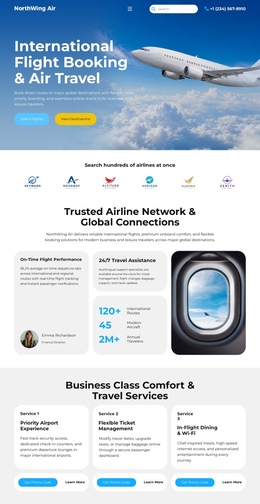
The four metric pairs create a compact information landmark between longer editorial sections. After that interruption, the feature row offers four parallel destinations or scan points: mobile apps, outlets, connections, and lounges. Their repeated format helps visitors understand that these are related categories, while the closing Gallery section provides a deeper lounge-focused destination with a large image, supporting thumbnails, and explanatory copy.
This arrangement supports continuous navigation because the page contains several meaningful content groups rather than one uninterrupted article block. It also preserves a logical progression from the comparison headline, through practical onboard details and compact summaries, to lounge content near the end. The verified analysis does not confirm anchor navigation, so the design should be interpreted as a suitable one-page information structure rather than as proof that linked section anchors are already installed.
Customize with Nicepage
Open this ready-made template in the One Page Template Builder and customize it visually in the Nicepage editor. Replace demo content, edit page sections, and adapt the design to your project without rebuilding the template from scratch.
Build a Navigable One-Page Website
Connect the Menu to Page Sections
Organize the website as a sequence of sections on a single page and use the Menu For One-Page Site to connect menu items with individual page Blocks. Visitors can jump directly to sections such as About, Services, Testimonials, or Contact without opening separate pages.
Keep the Website on One URL
A one-page template can combine several parts of a small website within one continuous page. Arrange the Header, introduction, services, portfolio, company information, reviews, contact details, and other relevant sections in the order that fits the project while keeping them accessible through the same page navigation.
Make Long Pages Easier to Navigate
For longer one-page websites, keep navigation labels short and connected to meaningful sections so visitors can move through the page without relying only on scrolling. You can also use the Back To Top element to provide a quick way back to the beginning after longer sections.
This workflow makes the template suitable for compact websites that need several distinct content sections while keeping the complete visitor experience on one URL.