Creative Summit Event Landing Page
Edit Template Offline
2. Create new page and search for id 6626618
Edit Template Online
Create Awesome Websites


Free Nicepage Builder
Keywords
A Direct Route From Summit Promise to Registration
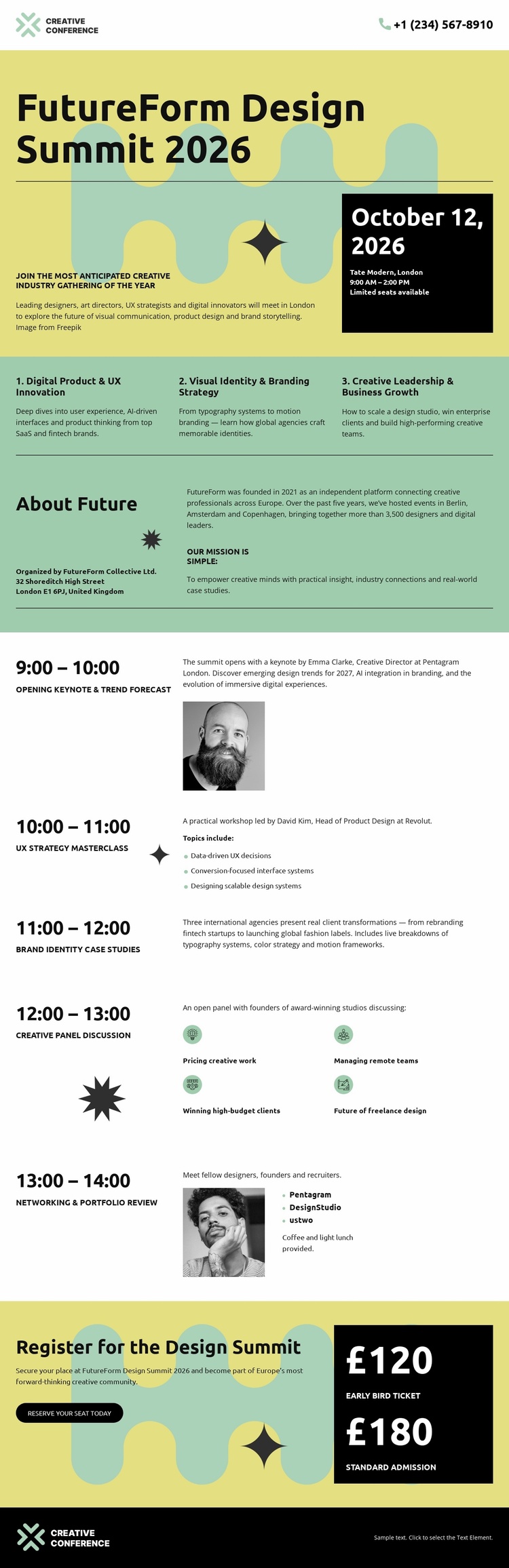
The opening section gives the page a strong first step in its response path: the summit title appears beside date and venue information, while the registration prompt identifies the intended next action. The three topic columns then answer a visitor’s immediate question about what the event covers. By placing product innovation, visual identity and branding, and creative leadership next to one another, the design communicates breadth without sending attention toward unrelated offers.
The About Summit block deepens that initial promise, and the chronological agenda supplies concrete reasons to continue. The program moves from an opening keynote through UX strategy, brand identity case studies, and creative pixel discussion before reaching networking and portfolio review. Selected speaker portraits add visual proof to the schedule, while the time-based order helps visitors understand how the event unfolds. These informational sections support registration without competing with it.
The final banner makes the response point unmistakable through the heading Register for the Design Summit. Its contrasting ticket panel presents £120 early bird and £180 standard admission, giving the action a visible commercial context. Because the page already separates message, program evidence, and ticket choice, a campaign can keep the registration action primary and use the agenda as reassurance. Nicepage’s Contact Form Element could support an inquiry or registration variation if required, but the verified page itself primarily shows a registration and ticket-purchase prompt.
Customize with Nicepage
Open this ready-made template in the Landing Page Builder and customize it visually in the Nicepage editor. Replace demo content, edit page sections, and adapt the design to your project without rebuilding the template from scratch.
Build a Landing Page Around One Conversion Goal
Focus on One Primary Action
Use the landing page to guide visitors toward one measurable response, such as requesting a quote, registering, subscribing, booking a consultation, applying for a service, or submitting an inquiry. Keep the primary call-to-action consistent across the important sections so the headline, supporting content, form, and CTA buttons work toward the same campaign goal instead of competing for attention.
Capture Leads With a Form
Use the Contact Form Element to add a contact, subscription, application, or other conversion form directly to the landing page. Customize the form fields, layout, labels, inputs, and button to collect the information required for your campaign while keeping the form focused on the action you want visitors to complete.
Nicepage also provides several form submission options. Form submissions can be sent to Email, stored as Leads, added to Google Sheets, passed to a custom URL or server endpoint, or used to populate a MailChimp mailing list. This provides practical options for collecting inquiries, registrations, subscriptions, applications, and other campaign responses.
Manage Leads and Campaign Responses
When submissions are stored as Leads, you can use Contact Form Leads to review the information collected through the landing page and use it for follow-up. Keep the form connected to the same offer and primary CTA presented throughout the page so visitors move from the campaign message to a clear conversion action.
This workflow makes the template suitable for landing pages where the offer, content, call-to-action, form, and lead collection process work together toward one defined conversion goal.

More from Art & Design Landing Pages
-
Free Website Builder SoftwareDownload