How I protect your data Landing Page
Edit Template Offline
2. Create new page and search for id 6542959
Edit Template Online
Create Awesome Websites


Free Nicepage Builder
Keywords
The Policy Explanation Builds Toward a Newsletter Response
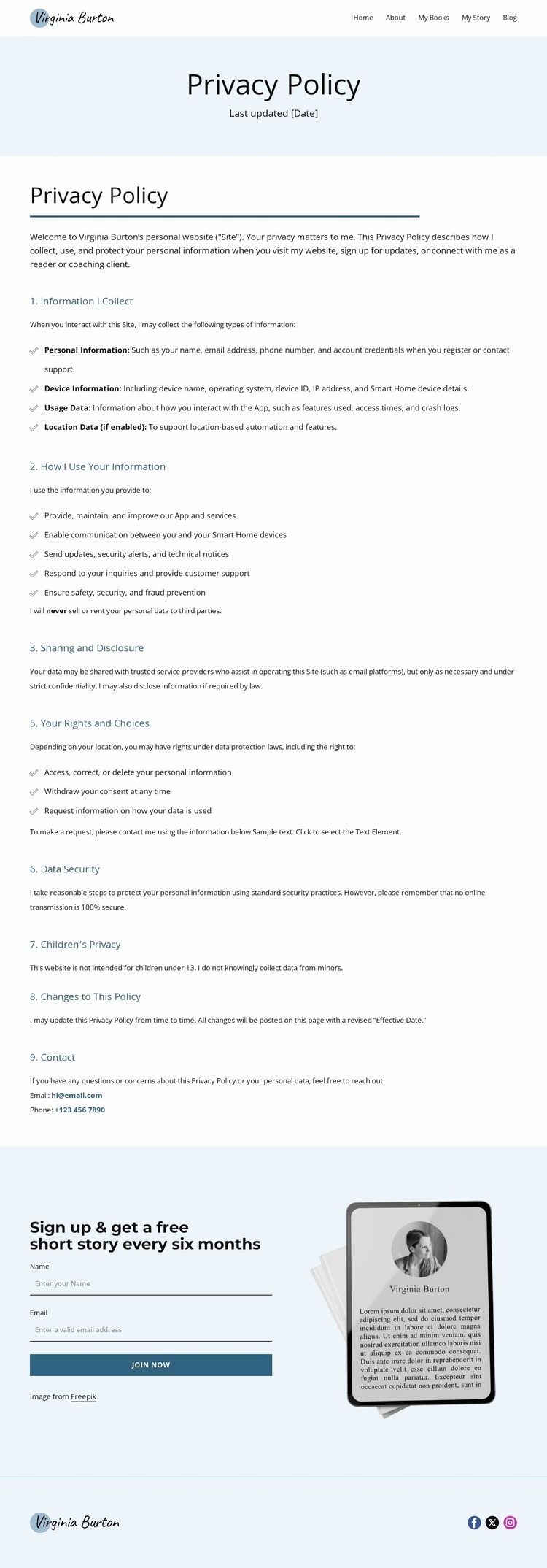
The page’s strongest response path begins with information rather than an immediate promotional claim. Visitors first encounter the Virginia Burton identity and familiar site navigation, then a centered Privacy Policy heading that sets expectations for the document. The numbered sections explain what information is collected, how it is used, how sharing and disclosure are addressed, and what rights, security, children’s privacy, policy changes, and contact options mean within the page structure. The verified statement that personal data will not be sold or rented to third parties gives the explanation a concrete point of reassurance.
Only after that extended information sequence does the design introduce the newsletter invitation. The heading offers a free short story every six months, the supporting copy frames the reason to subscribe, and the form with its Join Now action provides one clear response point. The device illustration strengthens the visual separation between the policy document and the subscription block, helping the final action feel intentional rather than incidental.
This makes the page suitable for a privacy-focused campaign or supporting landing page where trust must precede response. The content should preserve the distinction between policy information and the newsletter offer: the policy sections answer questions, while the closing form asks for a subscription. Nicepage’s Contact Form Element could support the real submission flow, but the important conversion logic is already visible in the verified sequence from transparent information to a single newsletter action.
Customize with Nicepage
Open this ready-made template in the Landing Page Builder and customize it visually in the Nicepage editor. Replace demo content, edit page sections, and adapt the design to your project without rebuilding the template from scratch.
Build a Landing Page Around One Conversion Goal
Focus on One Primary Action
Use the landing page to guide visitors toward one measurable response, such as requesting a quote, registering, subscribing, booking a consultation, applying for a service, or submitting an inquiry. Keep the primary call-to-action consistent across the important sections so the headline, supporting content, form, and CTA buttons work toward the same campaign goal instead of competing for attention.
Capture Leads With a Form
Use the Contact Form Element to add a contact, subscription, application, or other conversion form directly to the landing page. Customize the form fields, layout, labels, inputs, and button to collect the information required for your campaign while keeping the form focused on the action you want visitors to complete.
Nicepage also provides several form submission options. Form submissions can be sent to Email, stored as Leads, added to Google Sheets, passed to a custom URL or server endpoint, or used to populate a MailChimp mailing list. This provides practical options for collecting inquiries, registrations, subscriptions, applications, and other campaign responses.
Manage Leads and Campaign Responses
When submissions are stored as Leads, you can use Contact Form Leads to review the information collected through the landing page and use it for follow-up. Keep the form connected to the same offer and primary CTA presented throughout the page so visitors move from the campaign message to a clear conversion action.
This workflow makes the template suitable for landing pages where the offer, content, call-to-action, form, and lead collection process work together toward one defined conversion goal.

More from Business & Law Landing Pages
-
Free Website Builder SoftwareDownload