Faq page Landing Page
Edit Template Offline
2. Create new page and search for id 6416832
Edit Template Online
Create Awesome Websites


Free Nicepage Builder
Keywords
Five Student Questions Lead Toward a Personal Inquiry
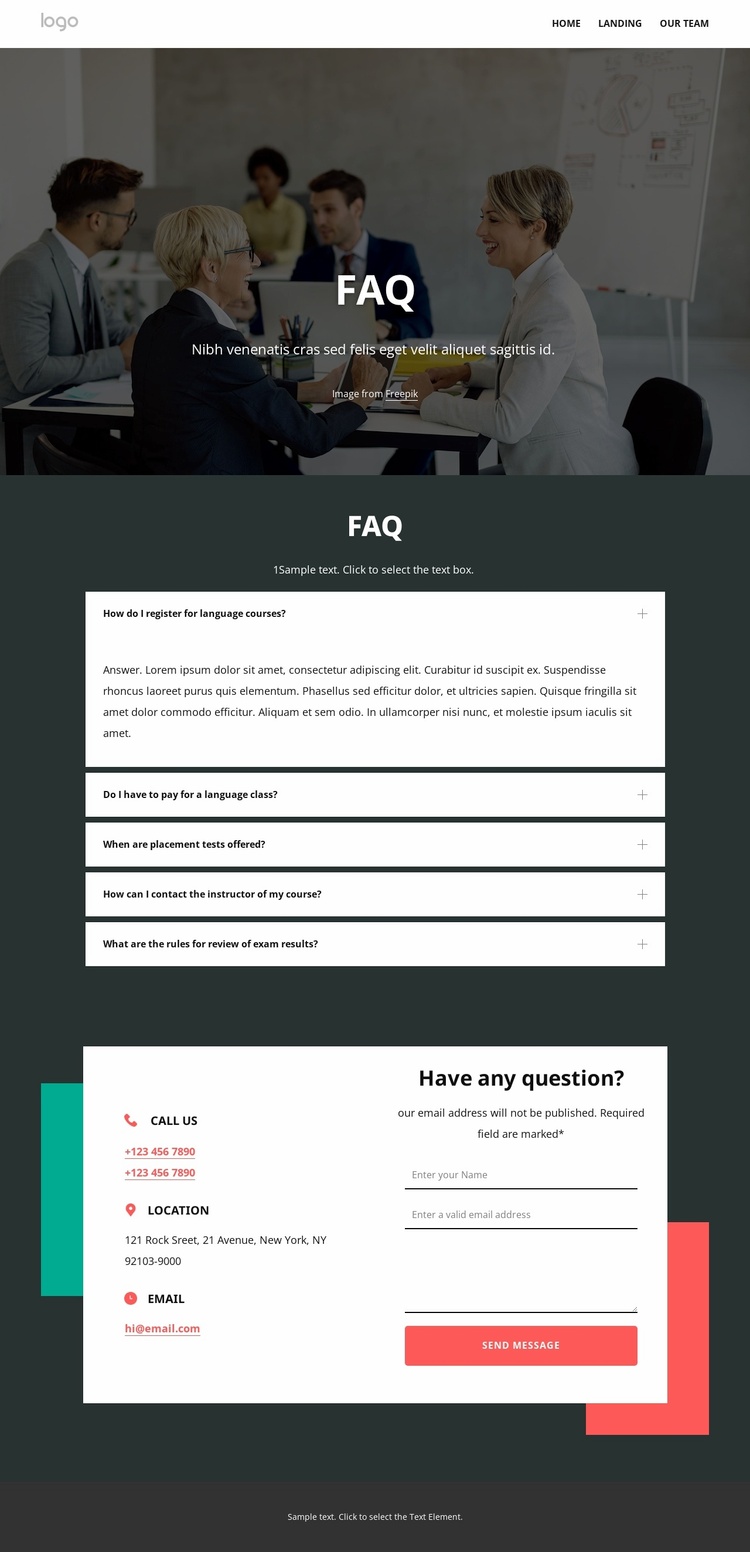
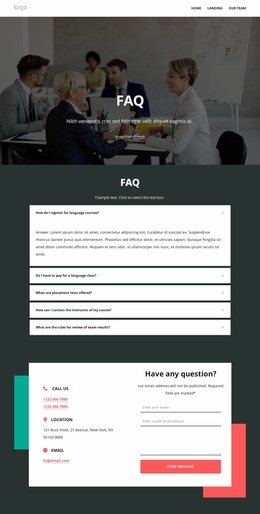
The classroom photograph creates an immediate context for visitors considering language study, and the centered FAQ heading identifies the page’s purpose before the detailed questions begin. The five accordion items then address practical concerns about registration, course fees, placement tests, instructor contact, and exam-result reviews. Together, these topics reduce uncertainty in a sequence that supports the visitor’s movement from general interest toward a more specific question.
Course links add another layer to that response path. Private lessons, online learning, English for kids, long-term courses, and English for business show the range of study options without replacing the FAQ’s central role. Visitors can first review answers, then recognize a relevant course direction, and finally reach the two-column contact area. There, phone, location, and email details sit beside a message form with a clear “Send Message” action, creating the page’s strongest response point.
The newsletter signup and footer links provide a secondary continuation for visitors who are not ready to contact the center immediately. They can move toward course information, help and support, or ongoing updates while the primary inquiry route remains visible in the page structure. Because the design builds trust through answers before presenting the form, it works as an action-focused page without relying on unsupported claims or invented offers. The conversion logic comes from the verified relationship between questions, course choices, and contact.
Customize with Nicepage
Open this ready-made template in the Landing Page Builder and customize it visually in the Nicepage editor. Replace demo content, edit page sections, and adapt the design to your project without rebuilding the template from scratch.
Build a Landing Page Around One Conversion Goal
Focus on One Primary Action
Use the landing page to guide visitors toward one measurable response, such as requesting a quote, registering, subscribing, booking a consultation, applying for a service, or submitting an inquiry. Keep the primary call-to-action consistent across the important sections so the headline, supporting content, form, and CTA buttons work toward the same campaign goal instead of competing for attention.
Capture Leads With a Form
Use the Contact Form Element to add a contact, subscription, application, or other conversion form directly to the landing page. Customize the form fields, layout, labels, inputs, and button to collect the information required for your campaign while keeping the form focused on the action you want visitors to complete.
Nicepage also provides several form submission options. Form submissions can be sent to Email, stored as Leads, added to Google Sheets, passed to a custom URL or server endpoint, or used to populate a MailChimp mailing list. This provides practical options for collecting inquiries, registrations, subscriptions, applications, and other campaign responses.
Manage Leads and Campaign Responses
When submissions are stored as Leads, you can use Contact Form Leads to review the information collected through the landing page and use it for follow-up. Keep the form connected to the same offer and primary CTA presented throughout the page so visitors move from the campaign message to a clear conversion action.
This workflow makes the template suitable for landing pages where the offer, content, call-to-action, form, and lead collection process work together toward one defined conversion goal.

Design Set (22)
-

-
-
Free Website Builder SoftwareDownload
-
-
-
-
-
-
-
-
-
-
-
-








More from Business & Law Landing Pages
-
Free Website Builder SoftwareDownload