meet our global team Landing Page
Edit Template Offline
2. Create new page and search for id 6319355
Edit Template Online
Create Awesome Websites


Free Nicepage Builder
Keywords
Team visibility leads naturally toward volunteer participation
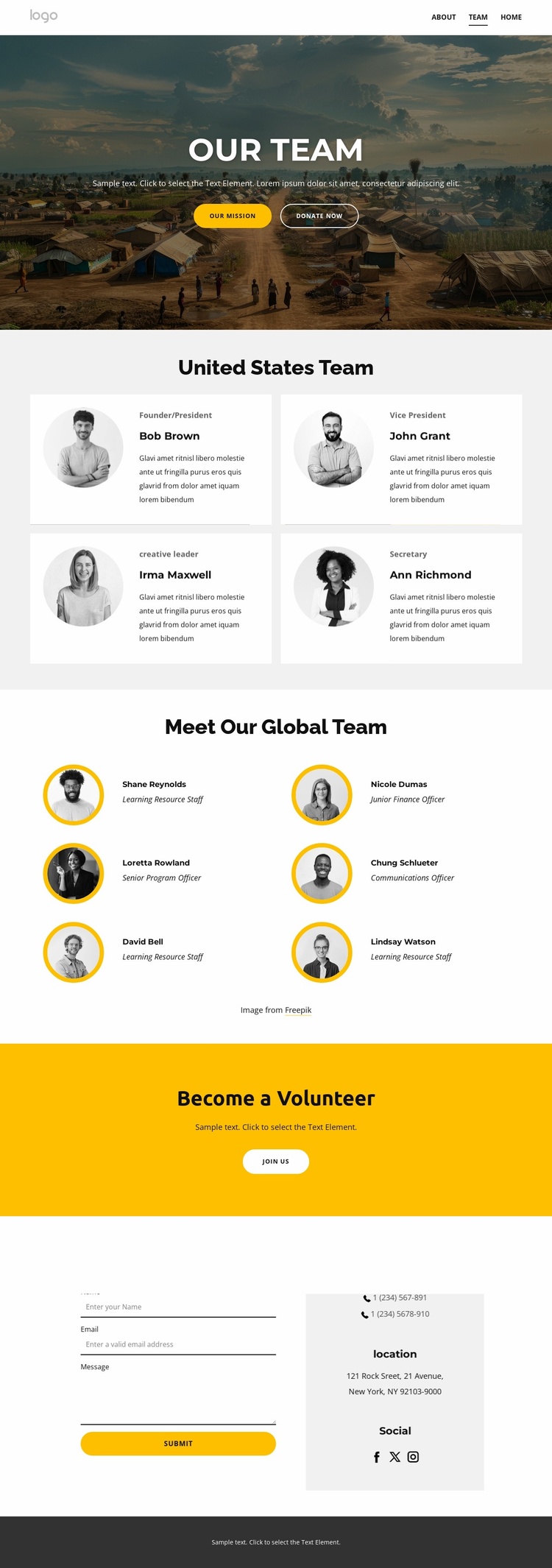
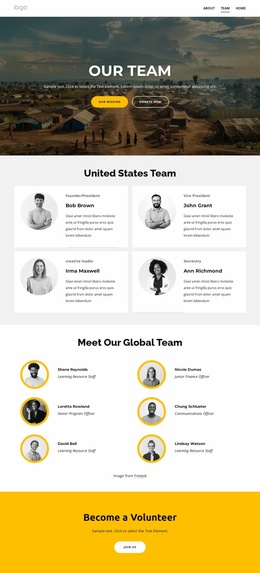
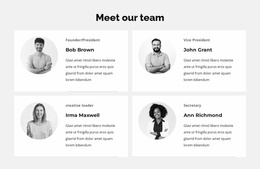
The opening hero establishes the page’s response path with the Our Team heading, a supporting introduction, and two adjacent actions: Our Mission and Donate now. These buttons present both an informational route and a direct support option before visitors reach the people-centered content. The four United States profiles then provide regional context through portraits, roles, names, and short descriptions, while the six global profiles extend that sense of organizational reach in a compact two-column arrangement.
The sequence gives the volunteer message a specific place rather than treating it as a generic footer invitation. After visitors have seen both team groups, the bright Become a Volunteer band changes the visual emphasis and presents Join us as the next participation step. This creates a progression from identity, to organizational evidence, to involvement. It is distinct from simply placing a form on an otherwise informational page.
The contact area provides a second response route for visitors whose needs are more individual. Its form requests a name, email address, and message, and the page also exposes a telephone contact channel. For a campaign adaptation, the primary emphasis could remain on volunteer recruitment while Donate now and direct inquiries are kept visually subordinate. The design therefore supports a clear action path without inventing a specific donation or registration workflow.
Customize with Nicepage
Open this ready-made template in the Landing Page Builder and customize it visually in the Nicepage editor. Replace demo content, edit page sections, and adapt the design to your project without rebuilding the template from scratch.
Build a Landing Page Around One Conversion Goal
Focus on One Primary Action
Use the landing page to guide visitors toward one measurable response, such as requesting a quote, registering, subscribing, booking a consultation, applying for a service, or submitting an inquiry. Keep the primary call-to-action consistent across the important sections so the headline, supporting content, form, and CTA buttons work toward the same campaign goal instead of competing for attention.
Capture Leads With a Form
Use the Contact Form Element to add a contact, subscription, application, or other conversion form directly to the landing page. Customize the form fields, layout, labels, inputs, and button to collect the information required for your campaign while keeping the form focused on the action you want visitors to complete.
Nicepage also provides several form submission options. Form submissions can be sent to Email, stored as Leads, added to Google Sheets, passed to a custom URL or server endpoint, or used to populate a MailChimp mailing list. This provides practical options for collecting inquiries, registrations, subscriptions, applications, and other campaign responses.
Manage Leads and Campaign Responses
When submissions are stored as Leads, you can use Contact Form Leads to review the information collected through the landing page and use it for follow-up. Keep the form connected to the same offer and primary CTA presented throughout the page so visitors move from the campaign message to a clear conversion action.
This workflow makes the template suitable for landing pages where the offer, content, call-to-action, form, and lead collection process work together toward one defined conversion goal.

Design Set (20)
-

-
Free Website Builder SoftwareDownload
-
-
-
-
-
-
-
-
-
-



More from Education Landing Pages
-
Free Website Builder SoftwareDownload