Let's talk Landing Page
Edit Template Offline
2. Create new page and search for id 6277884
Edit Template Online
Create Awesome Websites


Free Nicepage Builder
Keywords
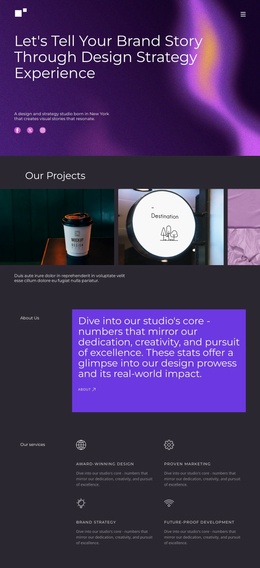
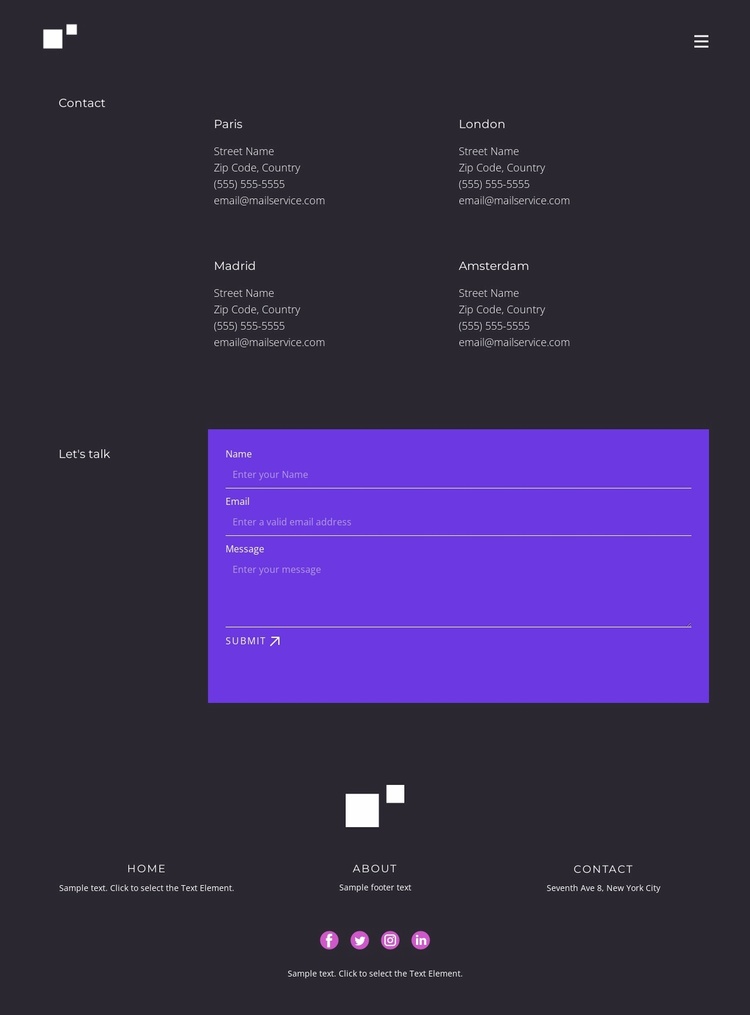
The Purple Form Panel Gives the Contact Journey a Clear Endpoint
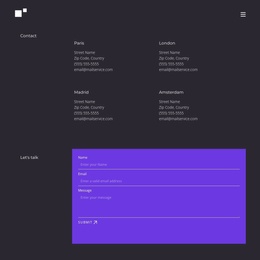
The page establishes its response path through a simple progression. The dark header identifies the site and keeps Home, About, and Contact available, while the first main section supplies context through four location entries. Because the locations are presented as a repeated two-column group, visitors can scan the available contact references before reaching the more direct inquiry route. The labels and address lines are placeholders, so they should be replaced with verified project information rather than treated as real offices.
The strongest action appears in the next section. A vivid purple panel contrasts with the dark charcoal background and contains name, email, and message inputs, followed by the Submit action. That visual contrast separates the response area from the supporting contact information and makes the intended interaction easy to identify. The field sequence also gives the page a practical request pattern without requiring additional offer, pricing, or testimonial sections that are not present in the analysis.
The footer reinforces the same destination by repeating Home, About, and Contact links while adding Facebook, Twitter, Instagram, and LinkedIn links. For a campaign or focused contact page, secondary navigation can remain limited while the form stays visually dominant. The result is a restrained path from orientation, through contact context, to message submission.
Customize with Nicepage
Open this ready-made template in the Landing Page Builder and customize it visually in the Nicepage editor. Replace demo content, edit page sections, and adapt the design to your project without rebuilding the template from scratch.
Build a Landing Page Around One Conversion Goal
Focus on One Primary Action
Use the landing page to guide visitors toward one measurable response, such as requesting a quote, registering, subscribing, booking a consultation, applying for a service, or submitting an inquiry. Keep the primary call-to-action consistent across the important sections so the headline, supporting content, form, and CTA buttons work toward the same campaign goal instead of competing for attention.
Capture Leads With a Form
Use the Contact Form Element to add a contact, subscription, application, or other conversion form directly to the landing page. Customize the form fields, layout, labels, inputs, and button to collect the information required for your campaign while keeping the form focused on the action you want visitors to complete.
Nicepage also provides several form submission options. Form submissions can be sent to Email, stored as Leads, added to Google Sheets, passed to a custom URL or server endpoint, or used to populate a MailChimp mailing list. This provides practical options for collecting inquiries, registrations, subscriptions, applications, and other campaign responses.
Manage Leads and Campaign Responses
When submissions are stored as Leads, you can use Contact Form Leads to review the information collected through the landing page and use it for follow-up. Keep the form connected to the same offer and primary CTA presented throughout the page so visitors move from the campaign message to a clear conversion action.
This workflow makes the template suitable for landing pages where the offer, content, call-to-action, form, and lead collection process work together toward one defined conversion goal.

Design Set (11)
-

-
-
-
-
-
-
-
Free Website Builder SoftwareDownload
-