Luxury Apartments Landing Page
Edit Template Offline
2. Create new page and search for id 24215
Edit Template Online
Create Awesome Websites


Free Nicepage Builder
Keywords
Apartment proof and Delft context lead toward a direct contact response
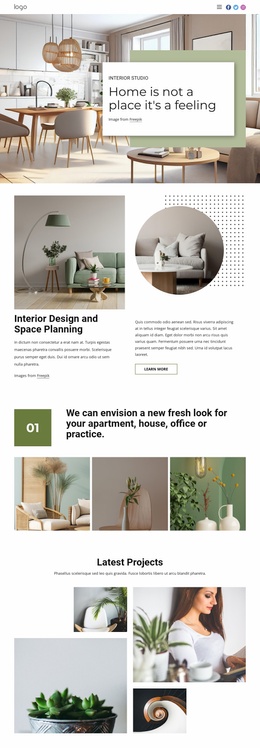
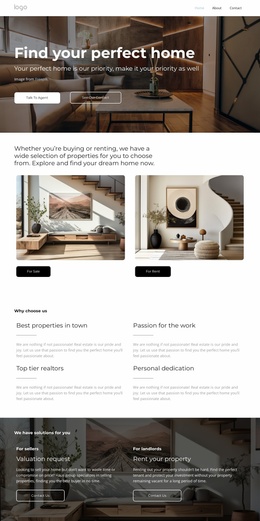
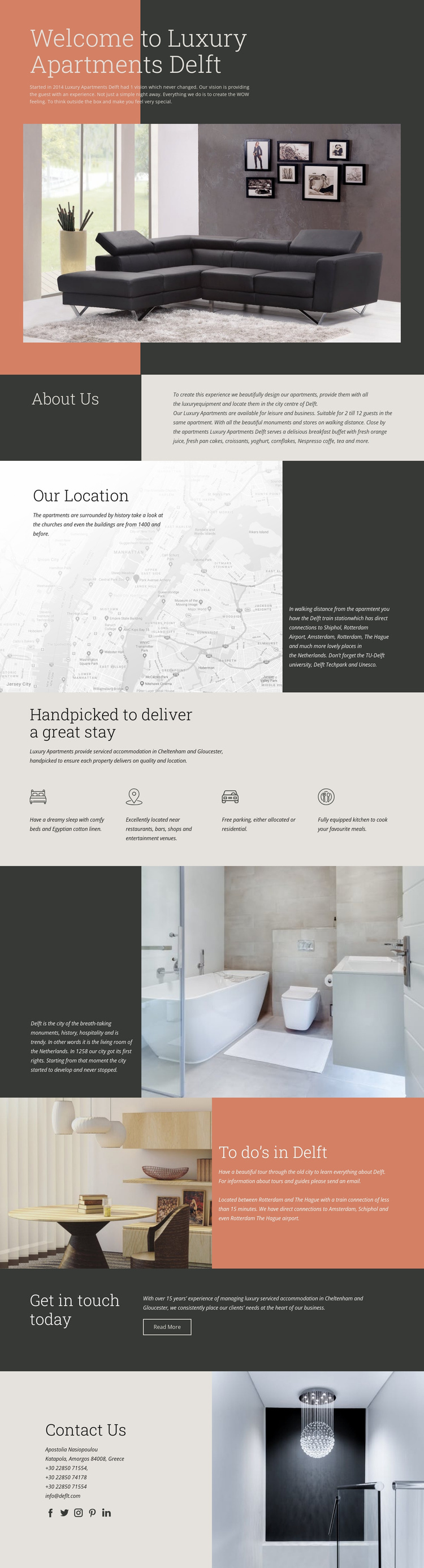
The page’s strongest response path begins with an immediate sense of place. The welcome section pairs the Luxury Apartments Delft message with a large living-room image, giving visitors an emotional and visual reason to continue. About Us then answers practical questions about the accommodation and guest suitability, reducing the distance between the opening impression and the decision to learn more.
The middle sections support that decision with two types of evidence. The four-item amenity grid makes specific stay details easy to scan: comfortable beds and linen, a central location, free parking, and an equipped kitchen. The Our Location section and the later Delft history and activity content broaden the offer beyond the interior, showing how the accommodation connects with its destination and transport options. These details can help leisure and business travelers evaluate the stay in context.
The final sequence gives the visitor a recognizable response point. “Get in touch today” narrows the page from general information toward contact, while the Read More action creates a visible next step. Contact Us then supplies direct contact details and social media links as a secondary reassurance and response area. Because the analysis does not verify one single booking, purchase, or inquiry form as the primary action, the design supports a contact-led campaign interpretation rather than proving a single conversion mechanism. The strongest landing-page use keeps communication as the dominant next step.
Customize with Nicepage
Open this ready-made template in the Landing Page Builder and customize it visually in the Nicepage editor. Replace demo content, edit page sections, and adapt the design to your project without rebuilding the template from scratch.
Build a Landing Page Around One Conversion Goal
Focus on One Primary Action
Use the landing page to guide visitors toward one measurable response, such as requesting a quote, registering, subscribing, booking a consultation, applying for a service, or submitting an inquiry. Keep the primary call-to-action consistent across the important sections so the headline, supporting content, form, and CTA buttons work toward the same campaign goal instead of competing for attention.
Capture Leads With a Form
Use the Contact Form Element to add a contact, subscription, application, or other conversion form directly to the landing page. Customize the form fields, layout, labels, inputs, and button to collect the information required for your campaign while keeping the form focused on the action you want visitors to complete.
Nicepage also provides several form submission options. Form submissions can be sent to Email, stored as Leads, added to Google Sheets, passed to a custom URL or server endpoint, or used to populate a MailChimp mailing list. This provides practical options for collecting inquiries, registrations, subscriptions, applications, and other campaign responses.
Manage Leads and Campaign Responses
When submissions are stored as Leads, you can use Contact Form Leads to review the information collected through the landing page and use it for follow-up. Keep the form connected to the same offer and primary CTA presented throughout the page so visitors move from the campaign message to a clear conversion action.
This workflow makes the template suitable for landing pages where the offer, content, call-to-action, form, and lead collection process work together toward one defined conversion goal.

More from Interior Landing Pages
-
Free Website Builder SoftwareDownload