Modern Military Defense HTML Template
Edit Template Offline
2. Create new page and search for id 6663841
Edit Template Online
Create Awesome Websites


Free Nicepage Builder
Keywords
Training, Proof, and Consultation Form a Finished Static Arrangement
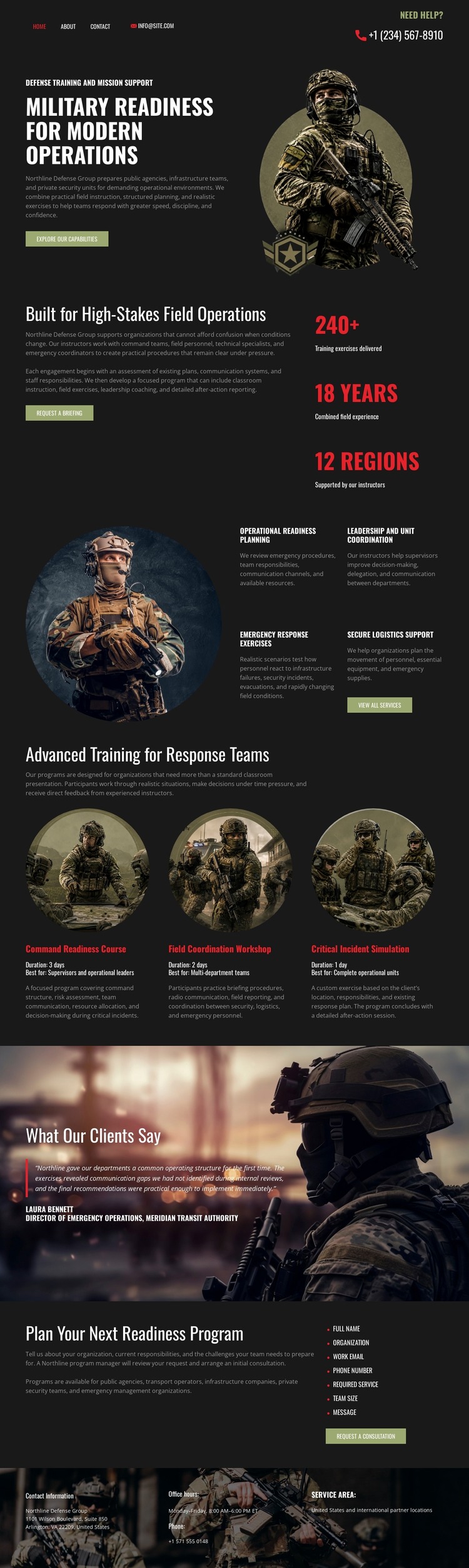
The page contains the main content groups needed for a self-contained military readiness presentation. Its opening block introduces the subject through a large personnel image, a readiness-focused heading, supporting text, and an exploratory button. The next split section adds operational context and highlighted structural metrics, while the features area explains planning, leadership coordination, emergency response, and specialized equipment. Together, these sections give the static page more substance than a hero-only concept.
The three advanced-training cards then provide a clear middle presentation for distinct capabilities. Their repeated image-led format creates a consistent way to replace the demonstrated descriptions with verified program information later. A testimonial-style banner adds a separate proof area, and the closing program section brings the visitor back to a practical response: reviewing listed inclusions and requesting a consultation. The footer completes the page with compact navigation, office information, and service-area columns.
This arrangement works as a standalone HTML template because the design already connects introduction, capabilities, supporting evidence, and contact intent in one coherent document. It does not depend on a claimed multi-page structure. Instead, it offers a finished static page foundation whose military photography, high-contrast palette, dense spacing, and condensed headings can carry the content without requiring the core sections to be built from scratch.
Customize with Nicepage
Open this ready-made template in the HTML Builder and customize it visually in the Nicepage editor. Replace demo content, edit page sections, and adapt the design to your project without rebuilding the template from scratch.
Export and Use This Template as an HTML Website
Create a Portable HTML Website
When the template is ready, use the HTML Export option to create a static website with the files required for deployment. The exported website can be used independently of the Nicepage editor and deployed on your preferred hosting.
Nicepage also provides SEO settings and optimization features, including Page Titles and Descriptions, Canonical settings, headings, image Alt Text, and other page-level properties that help prepare the website for search engines.
Deploy Without a CMS
Upload the finished website to the hosting environment that fits your project. Because the exported site does not require WordPress, Joomla, or another CMS to deliver its pages, it can be placed on your own server, uploaded to a hosting provider, or deployed through an existing web infrastructure.
Hand Off the Website Files
The generated website files can also be provided to a client, developer, or hosting team. They remain available outside the Nicepage editor for deployment, technical review, or project-specific development when additional work is required.
This workflow makes the template a practical foundation for a portable static website that can be exported from the Nicepage editor and deployed independently.

More from Education HTML Templates
-
Free Website Builder SoftwareDownload