Your trust, our responsibility HTML Template


Edit Template Offline
2. Create new page and search for id 6543910
Edit Template Online
Create Awesome Websites


Free Nicepage Builder
Keywords
Privacy Rights and Contact Details Form a Standalone Document
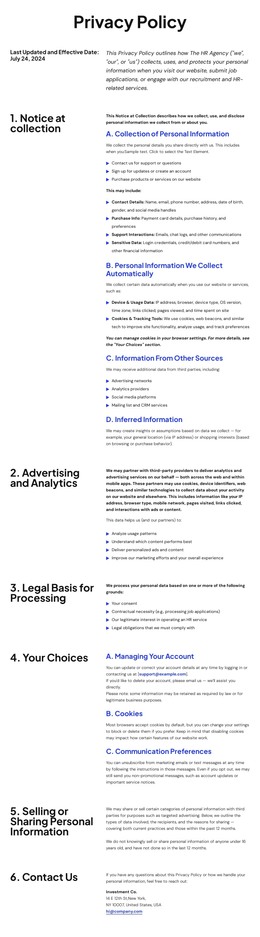
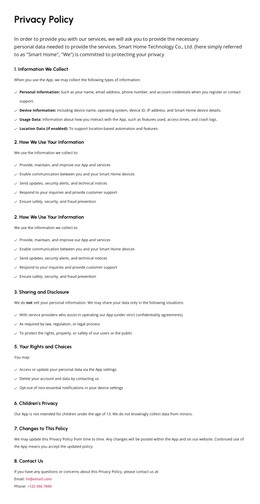
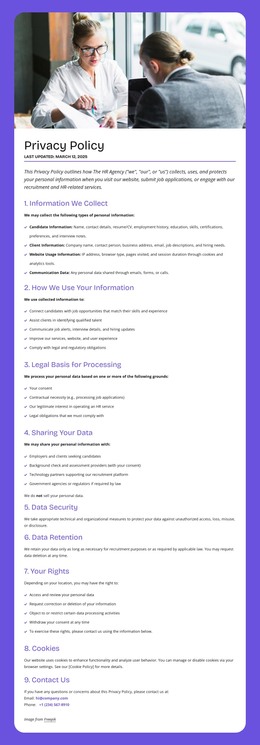
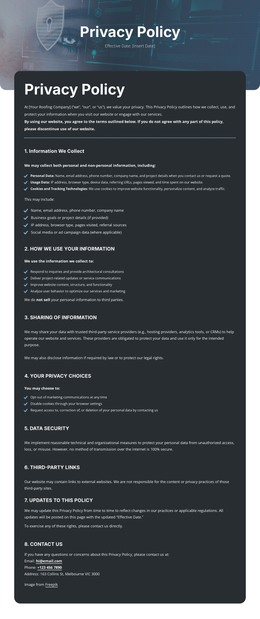
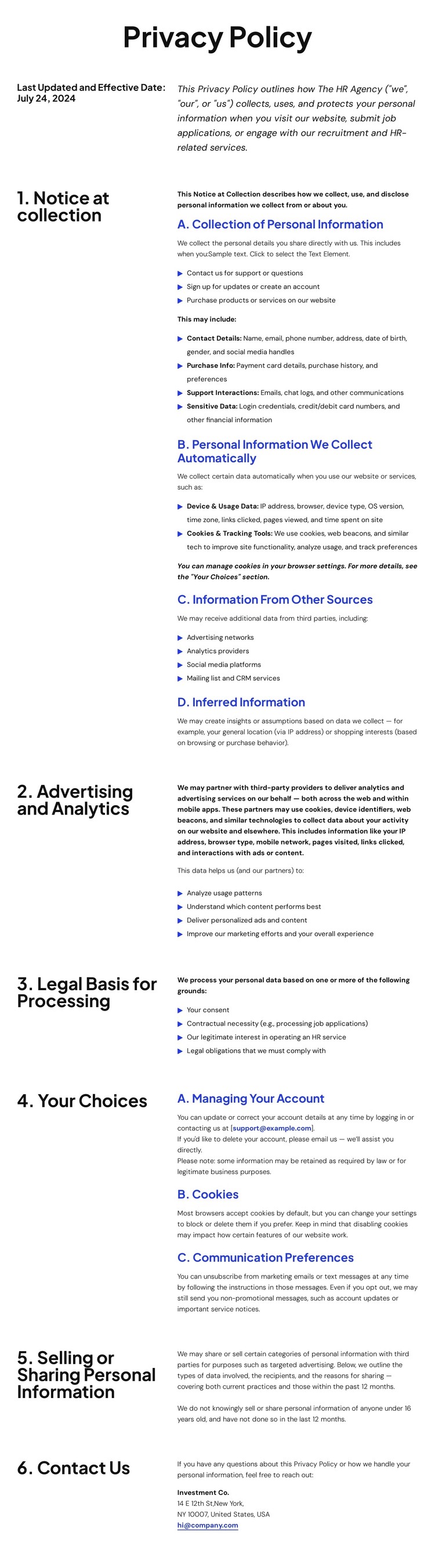
The page already arranges the principal content expected in a self-contained privacy policy document. Its introduction establishes the policy title, date, and scope, while the following sections move through collection practices, advertising and analytics, processing grounds, user choices, sharing, and privacy rights. This progression gives the static HTML implementation a complete reading path rather than leaving the legal content as a loose collection of paragraphs. The repeated two-column pattern reinforces that path: each left-hand title identifies the topic, and the right-hand column carries the explanatory text, subsections, or bullet list.
The final Contact Us section provides a defined endpoint for privacy inquiries, and the shared dark footer extends the page with help links, social links, postal information, email, and telephone channels. That combination makes the design usable as a focused standalone policy page within a broader site, while the header preserves access to the surrounding navigation and search. The provisions for U.S. and California residents also show how the document accommodates regional rights without changing the basic page structure. Before using the finished static implementation, the organization names, addresses, dates, and contact values should be checked carefully: the analysis reports conflicting organization references and different underlying email information, and several visible contact values are placeholders.
Customize with Nicepage
Open this ready-made template in the HTML Builder and customize it visually in the Nicepage editor. Replace demo content, edit page sections, and adapt the design to your project without rebuilding the template from scratch.
Export and Use This Template as an HTML Website
Create a Portable HTML Website
When the template is ready, use the HTML Export option to create a static website with the files required for deployment. The exported website can be used independently of the Nicepage editor and deployed on your preferred hosting.
Nicepage also provides SEO settings and optimization features, including Page Titles and Descriptions, Canonical settings, headings, image Alt Text, and other page-level properties that help prepare the website for search engines.
Deploy Without a CMS
Upload the finished website to the hosting environment that fits your project. Because the exported site does not require WordPress, Joomla, or another CMS to deliver its pages, it can be placed on your own server, uploaded to a hosting provider, or deployed through an existing web infrastructure.
Hand Off the Website Files
The generated website files can also be provided to a client, developer, or hosting team. They remain available outside the Nicepage editor for deployment, technical review, or project-specific development when additional work is required.
This workflow makes the template a practical foundation for a portable static website that can be exported from the Nicepage editor and deployed independently.

Design Set (20)
-
Free Website Builder SoftwareDownload
-

-
-
-
-
-
-
-
-
-