We're sustainable HTML Template


A Finished Contact Section for Static HTML Use
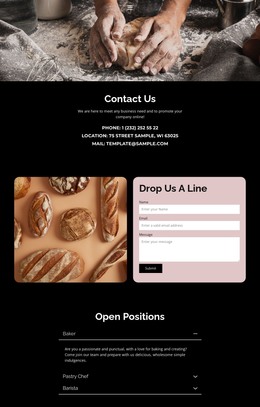
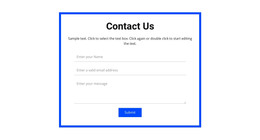
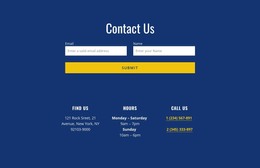
The heading, contact fields, submission control, and bakery image already work together as one prepared section. “Contact Us” identifies the purpose immediately, the email and name fields create a concise information-collection row, and the full-width Submit button provides the form’s final action. The light central area keeps these controls readable, while the warm bakery image frames them without replacing the form’s hierarchy. Rounded white fields and the black pill-shaped button reinforce that separation, and the Freepik credit line remains part of the supporting content.
Inside a static HTML page, this block can be placed as the contact area without requiring the surrounding page to be reconstructed from its internal arrangement. Other sections can handle introductions, food or bakery information, navigation, and additional content, while this section retains its specific role for contact details. Its centered composition is especially suited to a page flow that needs a visually distinct closing or inquiry region, although the block itself remains one reusable section rather than a complete page. The background image provides immediate food-related context, while the form controls keep the section functional and direct. Static implementation can therefore preserve the complete content relationship already present: contextual image around the edges, centered heading and credit line, paired fields, and one prominent submission action.
Customize with Nicepage
Open this ready-made template in the HTML Builder and customize it visually in the Nicepage editor. Replace demo content, edit page sections, and adapt the design to your project without rebuilding the template from scratch.
Edit Template Offline
2. Create a new page or select existing
3. Click Add new block, search for id 6166959 and click enter
Edit Template Online
Create Awesome Websites


Free Nicepage Builder
Keywords
Use This Block in a Static HTML Page
Start With a Ready-Made Section
A block provides one prepared content area that can be combined with other sections to build a static HTML page. Customize its text, images, spacing, colors, and other elements in the Nicepage editor while keeping the block focused on its own purpose, such as services, testimonials, pricing, contact information, or visual presentation.
Export the Containing HTML Project
When the page or website that contains the block is ready, use HTML Export to create the files required for a static HTML project. The export applies to the containing page/site rather than turning one individual block into a complete website by itself.
Reuse the Section Within the Project
The same block design can be adapted as one content section within a larger static site. Other Blocks can provide navigation, introductions, portfolios, forms, footers, and additional page content while this section keeps its own verified content and layout role.
This workflow makes the block useful as a ready-made section inside a static HTML implementation, with export and deployment handled at the page or website level.