Look for contacts HTML Template
Edit Template Offline
2. Create new page and search for id 5733978
Edit Template Online
Create Awesome Websites


Free Nicepage Builder
Keywords
A Phone Prompt, Map, and Newsletter Form in One Static Contact Page
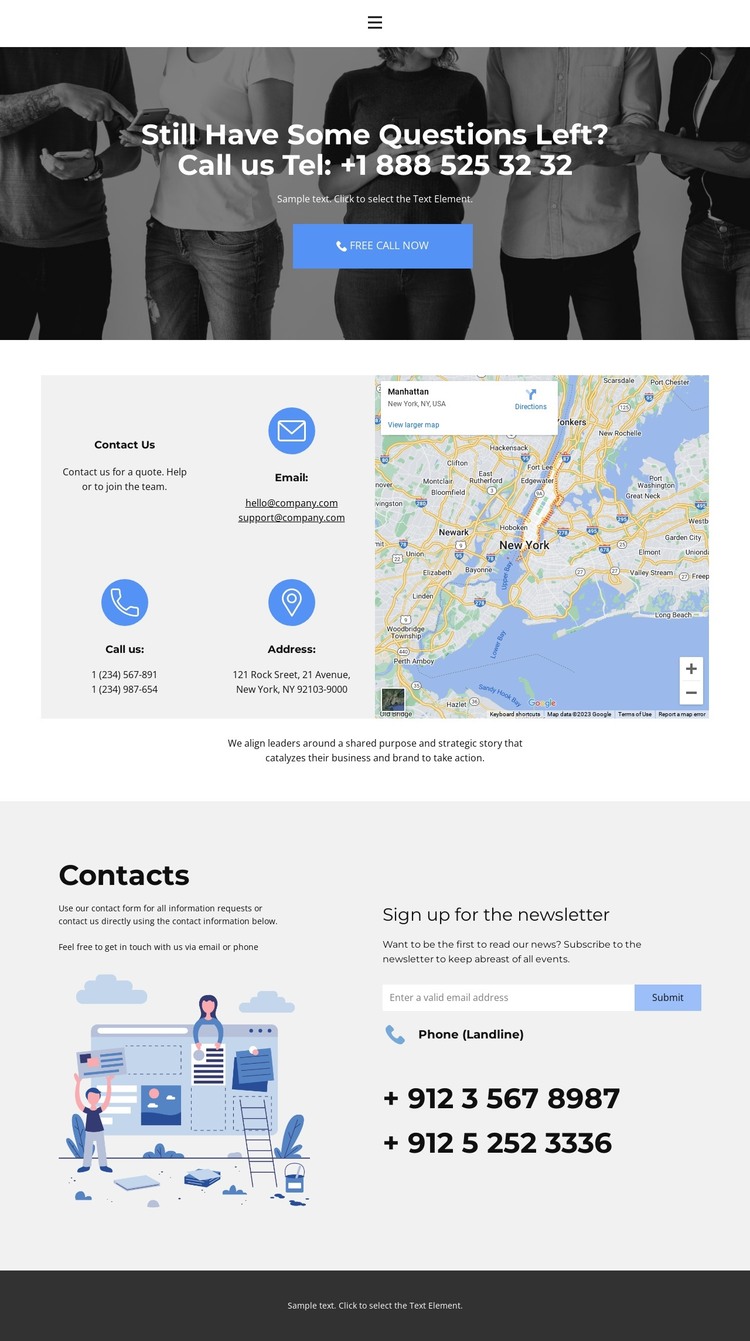
The phone-oriented hero gives the page an immediate opening message: visitors see a question prompt, a telephone detail, and a Call now action over a full-width photographic background. That first block establishes direct contact as the page’s starting point rather than treating the contact details as secondary footer content. The following Contacts section broadens the information by arranging four contact cards beside a large map, allowing email, telephone, and address references to sit alongside a visual location panel.
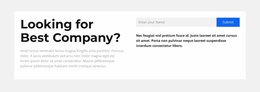
The lower contact block adds a different response path without breaking the page’s overall purpose. Its two-column arrangement combines guidance, an illustration, phone information, and a newsletter subscription form with a Submit button. This gives the finished static implementation both immediate contact content and an ongoing subscription option. Spacious cards, centered sans-serif type, pale blue and muted grayscale surfaces, and the dark footer keep these varied sections visually coordinated. As an HTML template, the design already supplies a self-contained arrangement of navigation, contact information, map content, direct-call messaging, subscription interaction, and closing footer text, so it functions as a complete contact-page foundation rather than only a hero concept.
Customize with Nicepage
Open this ready-made template in the HTML Builder and customize it visually in the Nicepage editor. Replace demo content, edit page sections, and adapt the design to your project without rebuilding the template from scratch.
Export and Use This Template as an HTML Website
Create a Portable HTML Website
When the template is ready, use the HTML Export option to create a static website with the files required for deployment. The exported website can be used independently of the Nicepage editor and deployed on your preferred hosting.
Nicepage also provides SEO settings and optimization features, including Page Titles and Descriptions, Canonical settings, headings, image Alt Text, and other page-level properties that help prepare the website for search engines.
Deploy Without a CMS
Upload the finished website to the hosting environment that fits your project. Because the exported site does not require WordPress, Joomla, or another CMS to deliver its pages, it can be placed on your own server, uploaded to a hosting provider, or deployed through an existing web infrastructure.
Hand Off the Website Files
The generated website files can also be provided to a client, developer, or hosting team. They remain available outside the Nicepage editor for deployment, technical review, or project-specific development when additional work is required.
This workflow makes the template a practical foundation for a portable static website that can be exported from the Nicepage editor and deployed independently.

Design Set (16)
-

-
-
-
-
-
-
-
Free Website Builder SoftwareDownload
-
-
-
-
-
-







More from Business & Law HTML Templates
-
Free Website Builder SoftwareDownload