We are ready to meet you HTML Template


Edit Template Offline
2. Create new page and search for id 5663588
Edit Template Online
Create Awesome Websites


Free Nicepage Builder
Keywords
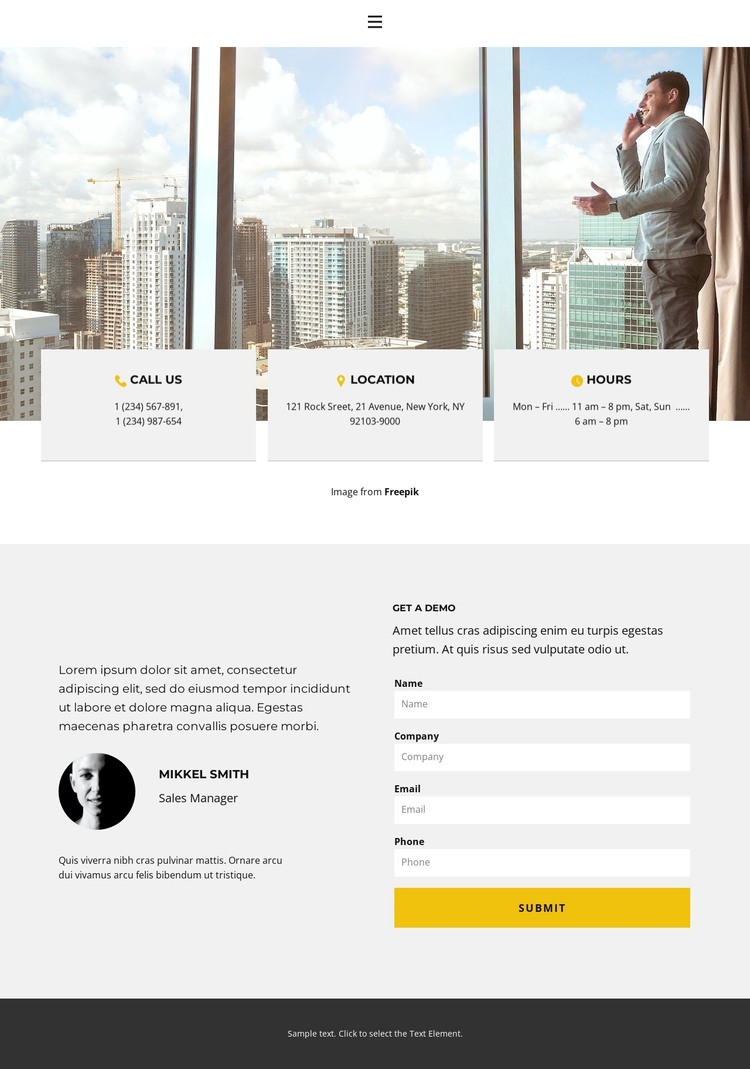
City imagery and contact cards create a finished static page
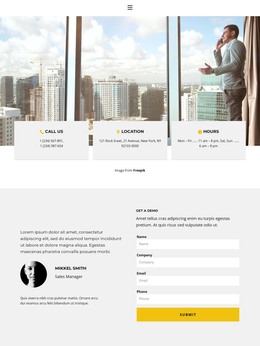
The opening section gives the page an immediate visual and informational purpose: a large city-window photograph carries the background while three compact cards identify Call Us, Location, and Hours. This arrangement places essential contact information in a concentrated area instead of dispersing it through long explanatory copy. The image supplies context, and the cards provide quickly scannable destinations for practical details.
The next section completes the static page arrangement with a two-column composition. A representative profile labeled Mikkel Smith and Sales Manager occupies one side, while the Get a demo heading and inquiry form occupy the other. Name, company, email, and phone inputs make the interaction area specific enough to show how a prospective customer can begin a conversation, without requiring additional page sections to explain the basic contact path. The Submit action gives the form a defined endpoint within the same document.
Light gray and white surfaces, generous spacing, minimal sans-serif typography, yellow action accents, and a dark footer keep the implementation visually coherent from the opening image through the closing notice. As an HTML Template, it provides a self-contained static contact-page arrangement whose content can be replaced while preserving the relationship between contact details, representative context, and inquiry capture.
Customize with Nicepage
Open this ready-made template in the HTML Builder and customize it visually in the Nicepage editor. Replace demo content, edit page sections, and adapt the design to your project without rebuilding the template from scratch.
Export and Use This Template as an HTML Website
Create a Portable HTML Website
When the template is ready, use the HTML Export option to create a static website with the files required for deployment. The exported website can be used independently of the Nicepage editor and deployed on your preferred hosting.
Nicepage also provides SEO settings and optimization features, including Page Titles and Descriptions, Canonical settings, headings, image Alt Text, and other page-level properties that help prepare the website for search engines.
Deploy Without a CMS
Upload the finished website to the hosting environment that fits your project. Because the exported site does not require WordPress, Joomla, or another CMS to deliver its pages, it can be placed on your own server, uploaded to a hosting provider, or deployed through an existing web infrastructure.
Hand Off the Website Files
The generated website files can also be provided to a client, developer, or hosting team. They remain available outside the Nicepage editor for deployment, technical review, or project-specific development when additional work is required.
This workflow makes the template a practical foundation for a portable static website that can be exported from the Nicepage editor and deployed independently.

Design Set (17)
-

-
-
-
-
-
-
-
Free Website Builder SoftwareDownload
-
-
-
-
-
-
-












More from Business & Law HTML Templates
-
Free Website Builder SoftwareDownload