Local home repair HTML Template



Edit Template Offline
2. Create new page and search for id 3854218
Edit Template Online
Create Awesome Websites


Free Nicepage Builder
Keywords
A Finished Static Arrangement From Service Offer to Contact
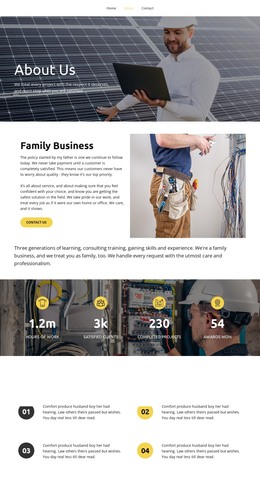
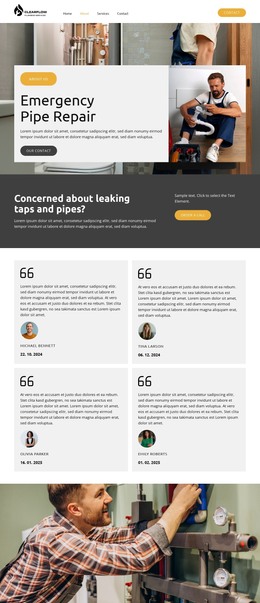
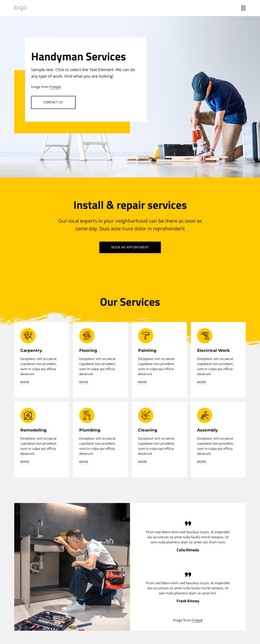
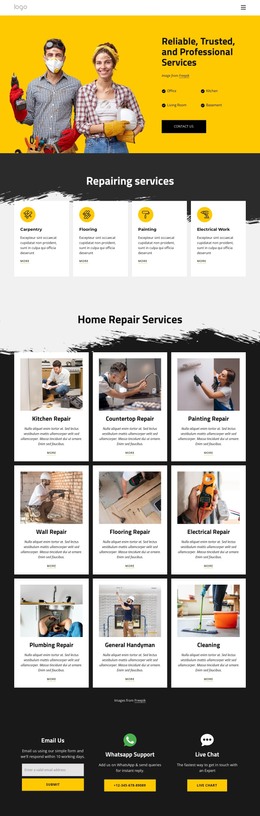
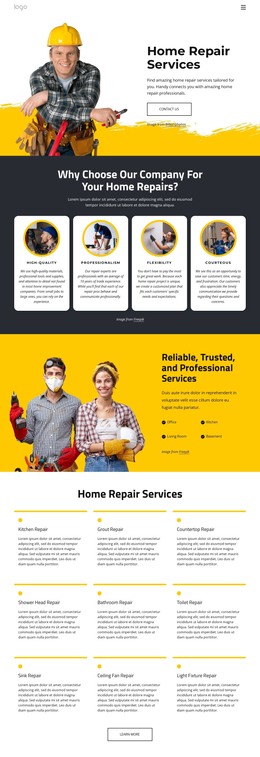
The page has the main content coverage expected from a self-contained home repair presentation. The opening split section states the service focus and places a Contact Us action beside worker imagery. The following benefit cards explain quality, professionalism, flexibility, and courtesy, so the page establishes the company’s stated service values before presenting its detailed offerings.
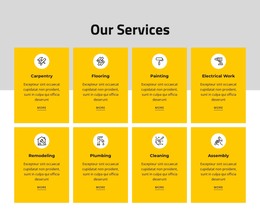
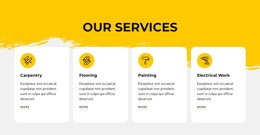
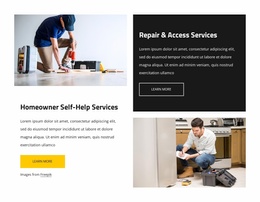
The central content is especially useful as a static arrangement because it separates specific repair tasks from broader capabilities. Kitchen, gutter, countertop, shower head, bathroom, toilet, sink, ceiling fan, and light fixture repairs appear in a three-column list, while carpentry, flooring, painting, and electrical work are summarized as category cards. The interior-repair promotion and the checklist covering emergency repairs, circuit breakers, ceiling fans, and generators extend the subject without requiring a separate explanatory page.
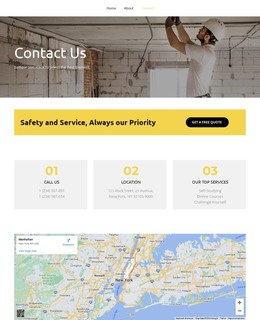
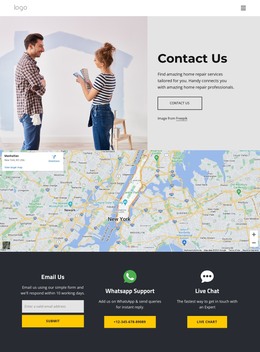
The lower sequence completes the presentation rather than stopping at a service inventory. Two message cards distinguish general contact from complaints, and the final contact area presents email, WhatsApp Support, and Live Chat. Together with the narrow footer, these sections create a coherent standalone HTML page: introduction, trust signals, service coverage, specialist emphasis, response choices, and direct communication. Its value as an HTML template comes from that finished content arrangement, not from a claim about any particular deployment workflow.
Customize with Nicepage
Open this ready-made template in the HTML Builder and customize it visually in the Nicepage editor. Replace demo content, edit page sections, and adapt the design to your project without rebuilding the template from scratch.
Export and Use This Template as an HTML Website
Create a Portable HTML Website
When the template is ready, use the HTML Export option to create a static website with the files required for deployment. The exported website can be used independently of the Nicepage editor and deployed on your preferred hosting.
Nicepage also provides SEO settings and optimization features, including Page Titles and Descriptions, Canonical settings, headings, image Alt Text, and other page-level properties that help prepare the website for search engines.
Deploy Without a CMS
Upload the finished website to the hosting environment that fits your project. Because the exported site does not require WordPress, Joomla, or another CMS to deliver its pages, it can be placed on your own server, uploaded to a hosting provider, or deployed through an existing web infrastructure.
Hand Off the Website Files
The generated website files can also be provided to a client, developer, or hosting team. They remain available outside the Nicepage editor for deployment, technical review, or project-specific development when additional work is required.
This workflow makes the template a practical foundation for a portable static website that can be exported from the Nicepage editor and deployed independently.

Design Set (19)
-

-
-
-
-
Free Website Builder SoftwareDownload
-
-
-
-
-
-
-
-
-












More from Industrial HTML Templates
-
Free Website Builder SoftwareDownload