Space-inspired architechture HTML Template
Edit Template Offline
2. Create new page and search for id 32542
Edit Template Online
Create Awesome Websites


Free Nicepage Builder
Keywords
Featured Stories and Project Cards Form a Standalone HTML Page
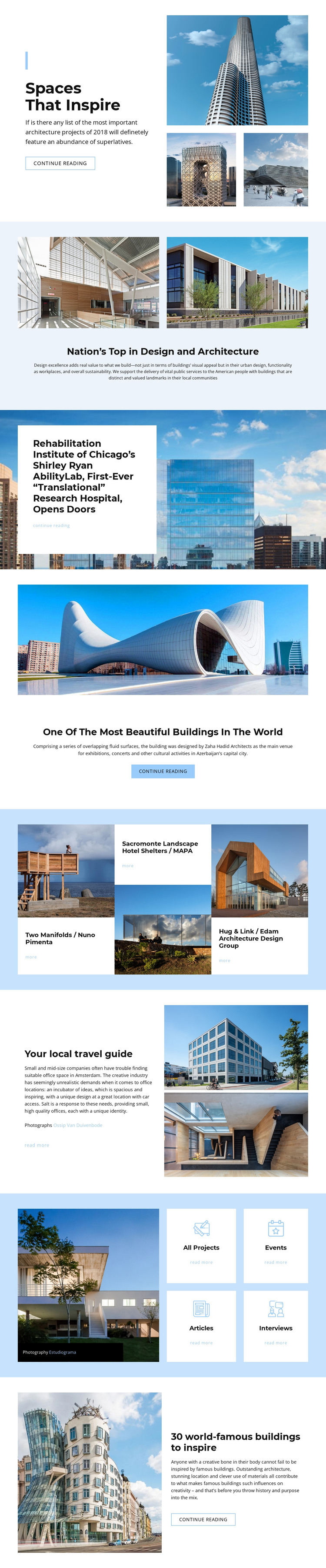
The opening composition already gives the page a clear editorial entry point: introductory text sits beside a three-image architecture arrangement, with a Continue reading action inviting visitors into the featured subject. That presentation is followed by a paired-image overview of design and sustainability, so the page can move from a broad architectural theme into more specific stories without needing a separate introductory build.
The central content provides several complete feature patterns. A large building photograph supports the Shirley Ryan AbilityLab headline through an overlaid white text card, while another building story places descriptive copy beneath a prominent image. The project grid then creates three self-contained items, each combining a project name, credited designer or group, an architectural photograph, and a More link. These units give the static page meaningful content variation rather than relying on a single repeated block.
The later local travel guide, category directory, and “30 world-famous buildings to inspire” feature extend the page’s usefulness as a standalone architecture presentation. Together they cover featured editorial content, project discovery, category navigation, image credits, and reading actions. As a static HTML implementation, the design therefore begins with a coherent content arrangement that can be adapted as one finished page rather than only serving as a visual sketch.
Customize with Nicepage
Open this ready-made template in the HTML Builder and customize it visually in the Nicepage editor. Replace demo content, edit page sections, and adapt the design to your project without rebuilding the template from scratch.
Export and Use This Template as an HTML Website
Create a Portable HTML Website
When the template is ready, use the HTML Export option to create a static website with the files required for deployment. The exported website can be used independently of the Nicepage editor and deployed on your preferred hosting.
Nicepage also provides SEO settings and optimization features, including Page Titles and Descriptions, Canonical settings, headings, image Alt Text, and other page-level properties that help prepare the website for search engines.
Deploy Without a CMS
Upload the finished website to the hosting environment that fits your project. Because the exported site does not require WordPress, Joomla, or another CMS to deliver its pages, it can be placed on your own server, uploaded to a hosting provider, or deployed through an existing web infrastructure.
Hand Off the Website Files
The generated website files can also be provided to a client, developer, or hosting team. They remain available outside the Nicepage editor for deployment, technical review, or project-specific development when additional work is required.
This workflow makes the template a practical foundation for a portable static website that can be exported from the Nicepage editor and deployed independently.

More from Architecture & Building HTML Templates
-
Free Website Builder SoftwareDownload