Surf Lessons HTML Template


Edit Template Offline
2. Create new page and search for id 24338
Edit Template Online
Create Awesome Websites


Free Nicepage Builder
Keywords
A Complete Surf School Page From Hero to Contact
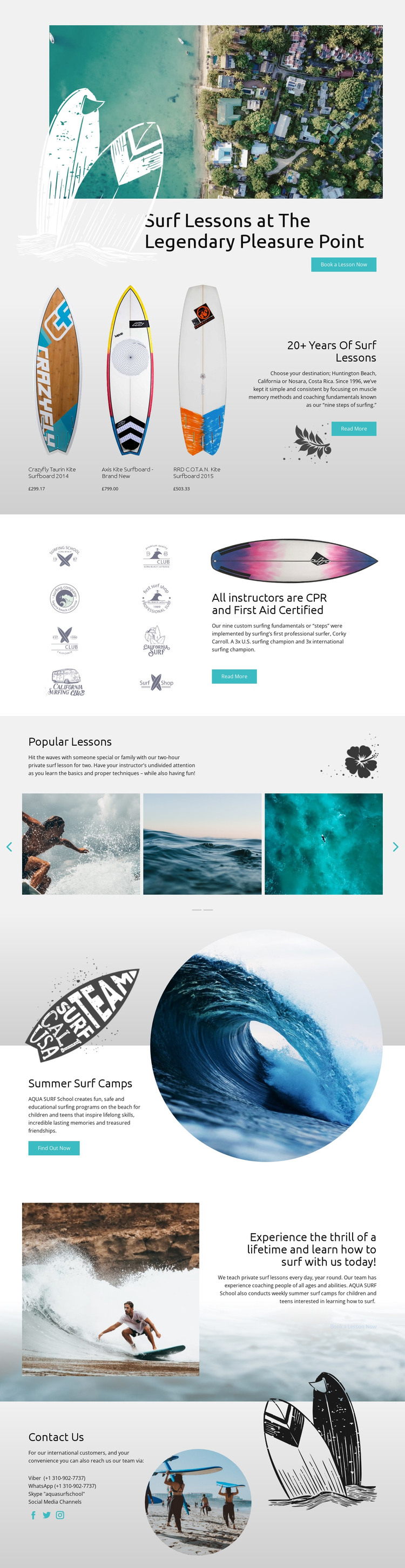
The large hero image, overlaid “Surf Lessons at The Legendary Pleasure Point” heading, and “Book a Lesson Now” button give the page a clear opening section for a standalone surf instruction presentation. The following split section adds a second content function by placing surf lesson information beside three kite surfboard product displays with names and displayed prices. Together, these areas allow the static page to introduce the school while also showing related equipment rather than presenting an isolated service message.
The page continues with instructor certification content, a repeated collection of eight surf-themed graphics, and a two-slide Popular Lessons carousel. This sequence adds credentials, visual variety, and specific lesson information before the Summer Surf Camps section addresses children and teens with a separate inquiry action. A final lesson panel returns to the booking message, then the Contact Us section closes the document with Viber, WhatsApp, Skype, social links, beach imagery, and surf illustration.
That progression makes the design usable as a self-contained HTML implementation: visitors can understand the offer, review supporting content, see products, and reach the school without requiring the core page sections to be built from scratch.
Customize with Nicepage
Open this ready-made template in the HTML Builder and customize it visually in the Nicepage editor. Replace demo content, edit page sections, and adapt the design to your project without rebuilding the template from scratch.
Export and Use This Template as an HTML Website
Create a Portable HTML Website
When the template is ready, use the HTML Export option to create a static website with the files required for deployment. The exported website can be used independently of the Nicepage editor and deployed on your preferred hosting.
Nicepage also provides SEO settings and optimization features, including Page Titles and Descriptions, Canonical settings, headings, image Alt Text, and other page-level properties that help prepare the website for search engines.
Deploy Without a CMS
Upload the finished website to the hosting environment that fits your project. Because the exported site does not require WordPress, Joomla, or another CMS to deliver its pages, it can be placed on your own server, uploaded to a hosting provider, or deployed through an existing web infrastructure.
Hand Off the Website Files
The generated website files can also be provided to a client, developer, or hosting team. They remain available outside the Nicepage editor for deployment, technical review, or project-specific development when additional work is required.
This workflow makes the template a practical foundation for a portable static website that can be exported from the Nicepage editor and deployed independently.

More from Sports HTML Templates
-
Free Website Builder SoftwareDownload