Fashion House HTML Template


Edit Template Offline
2. Create new page and search for id 21059
Edit Template Online
Create Awesome Websites


Free Nicepage Builder
Keywords
The Consultation Story Already Forms a Complete Static Page
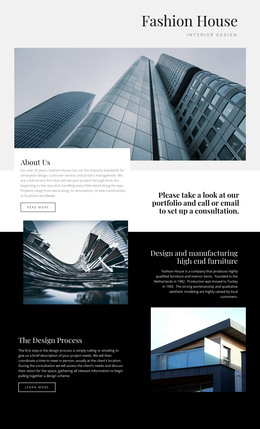
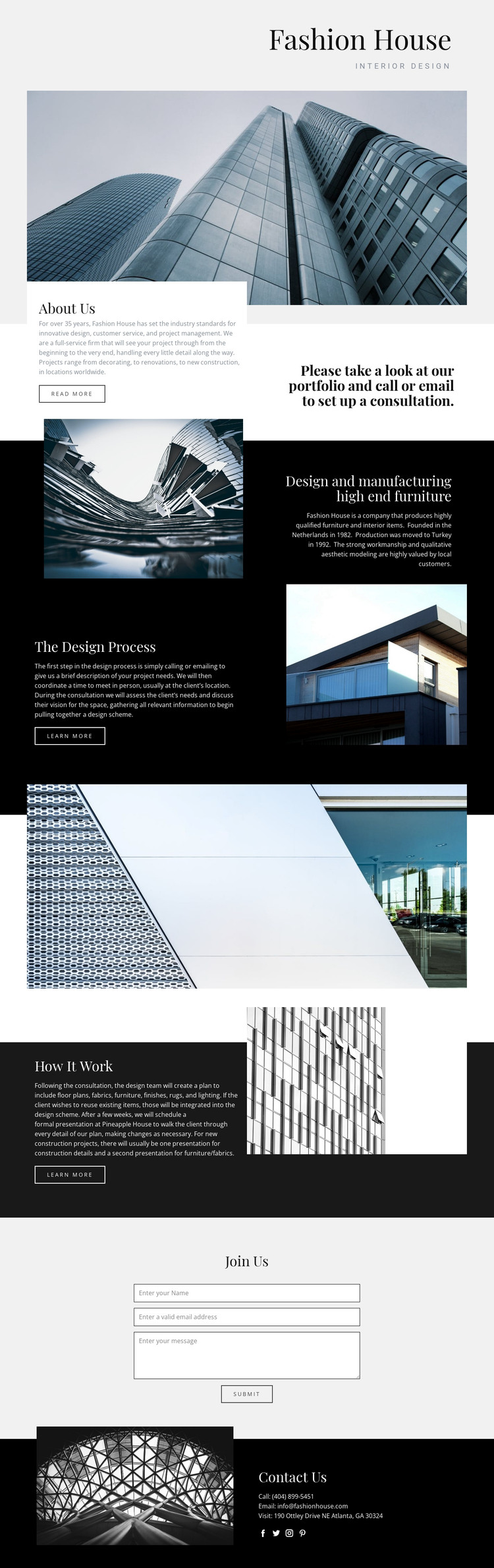
The opening architectural image gives the page an immediate subject, while the About Us section explains the company context and points visitors toward portfolio consultation. From there, the dark furniture-manufacturing section adds a tangible offering, and the two process sections explain what happens before and after consultation. Together, these areas create a finished informational arrangement rather than a collection of isolated visual blocks.
The sequence also provides a clear ending. A wide architectural image separates the process explanation from the centered Join Us form, allowing the inquiry action to appear as its own content stage. The form requests a name, email, and message, while the following Contact Us section supplies phone, email, physical address, and social links for visitors who prefer other contact channels.
That completeness makes Fashion House suitable as a standalone HTML implementation for an interior design profile or related service presentation. The page already covers identity, capabilities, workflow, inquiry, and contact discovery in one coherent document. Its alternating light and dark sections, paired imagery, and editorial typography give the static page a defined presentation without requiring the core content arrangement to be built from the beginning.
Customize with Nicepage
Open this ready-made template in the HTML Builder and customize it visually in the Nicepage editor. Replace demo content, edit page sections, and adapt the design to your project without rebuilding the template from scratch.
Export and Use This Template as an HTML Website
Create a Portable HTML Website
When the template is ready, use the HTML Export option to create a static website with the files required for deployment. The exported website can be used independently of the Nicepage editor and deployed on your preferred hosting.
Nicepage also provides SEO settings and optimization features, including Page Titles and Descriptions, Canonical settings, headings, image Alt Text, and other page-level properties that help prepare the website for search engines.
Deploy Without a CMS
Upload the finished website to the hosting environment that fits your project. Because the exported site does not require WordPress, Joomla, or another CMS to deliver its pages, it can be placed on your own server, uploaded to a hosting provider, or deployed through an existing web infrastructure.
Hand Off the Website Files
The generated website files can also be provided to a client, developer, or hosting team. They remain available outside the Nicepage editor for deployment, technical review, or project-specific development when additional work is required.
This workflow makes the template a practical foundation for a portable static website that can be exported from the Nicepage editor and deployed independently.

More from Real Estate HTML Templates
-
Free Website Builder SoftwareDownload