Building HTML Template


Edit Template Offline
2. Create new page and search for id 21011
Edit Template Online
Create Awesome Websites


Free Nicepage Builder
Keywords
A complete construction presentation from projects to inquiry
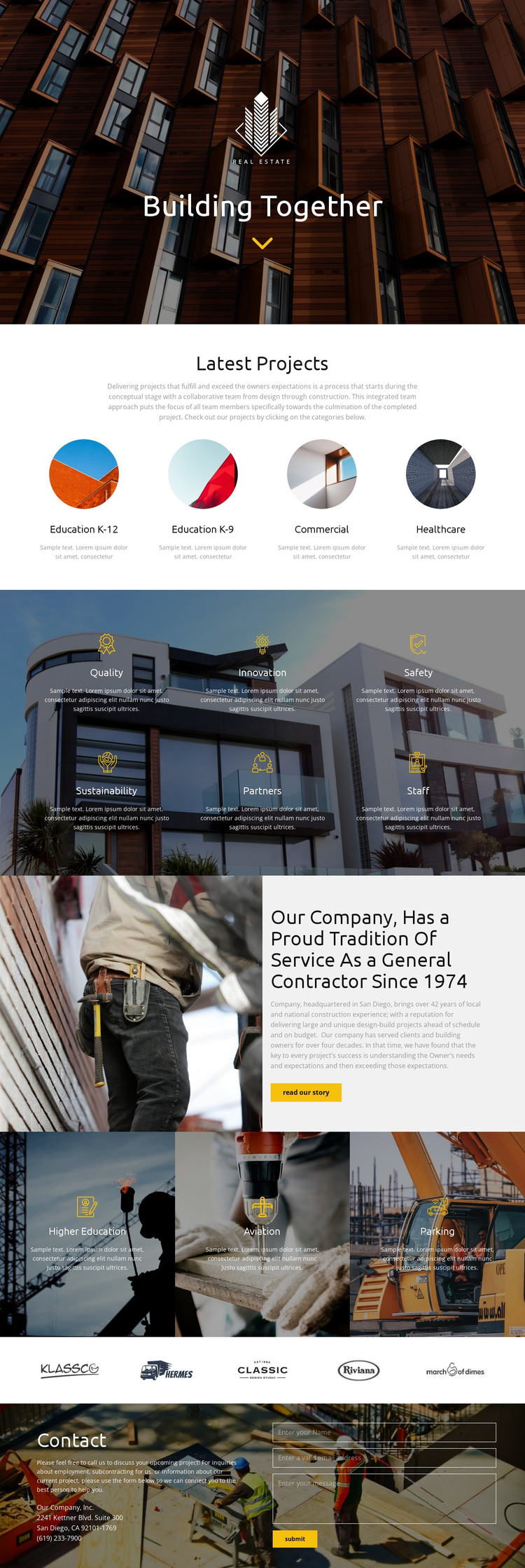
The page already connects the main content areas expected in a self-contained construction presentation. The opening “Building Together” hero establishes the subject through an architectural image, while “Latest Projects” immediately gives the visitor four portfolio categories: Education K-12, Education K-9, Commercial, and Healthcare. This makes the project focus visible before the page moves into broader statements about capabilities and company background.
The six-item values section adds a concise account of the organization’s stated priorities, including quality, innovation, safety, sustainability, partners, and staff. The adjacent company-history block then supplies a longer narrative context through its general-contractor heading, construction photograph, experience copy, and “Read our story” action. Together, these sections make the page more than a gallery: they connect work categories with the organization’s story and operating themes.
Three image-backed sector panels for higher education, aviation, and parking broaden the content coverage, while the five-logo row provides a compact client or partner showcase. The closing contact area completes the static implementation by bringing inquiry guidance, contact details, and name, email, and message inputs into one response section. Because the major content relationships are already present in the layout, the page can function as a finished standalone HTML arrangement after its sample copy and contact details are replaced with verified project content.
Customize with Nicepage
Open this ready-made template in the HTML Builder and customize it visually in the Nicepage editor. Replace demo content, edit page sections, and adapt the design to your project without rebuilding the template from scratch.
Export and Use This Template as an HTML Website
Create a Portable HTML Website
When the template is ready, use the HTML Export option to create a static website with the files required for deployment. The exported website can be used independently of the Nicepage editor and deployed on your preferred hosting.
Nicepage also provides SEO settings and optimization features, including Page Titles and Descriptions, Canonical settings, headings, image Alt Text, and other page-level properties that help prepare the website for search engines.
Deploy Without a CMS
Upload the finished website to the hosting environment that fits your project. Because the exported site does not require WordPress, Joomla, or another CMS to deliver its pages, it can be placed on your own server, uploaded to a hosting provider, or deployed through an existing web infrastructure.
Hand Off the Website Files
The generated website files can also be provided to a client, developer, or hosting team. They remain available outside the Nicepage editor for deployment, technical review, or project-specific development when additional work is required.
This workflow makes the template a practical foundation for a portable static website that can be exported from the Nicepage editor and deployed independently.

More from Business & Law HTML Templates
-
Free Website Builder SoftwareDownload