Happiness HTML Template


Edit Template Offline
2. Create new page and search for id 18701
Edit Template Online
Create Awesome Websites


Free Nicepage Builder
Keywords
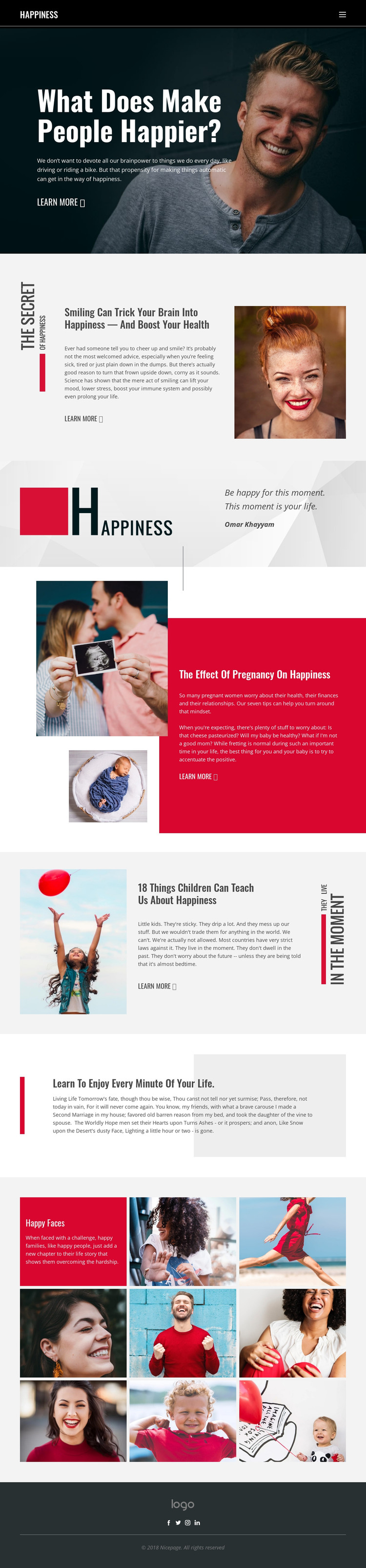
Editorial Features Form a Complete Static Page
The page already contains the main parts of a self-contained editorial presentation. A dark header establishes navigation and branding, the opening image-led feature introduces the subject, and the following article sections develop related ideas through headlines, compact copy, supporting photography, and repeated learn-more links. This arrangement gives the page a finished content progression rather than leaving the static implementation as a collection of disconnected visual sections.
The middle of the design adds useful variation without breaking that continuity. The Omar Khayyam quotation creates a centered pause between article features, while the pregnancy section uses an image and vivid red text panel for stronger emphasis. The children section reverses the earlier split arrangement, changing the image-to-text balance and preventing the page from becoming visually repetitive. A separate reflective passage then slows the pace before the Happy Faces gallery closes the main content with a repeated three-column mosaic of eight photo tiles.
That combination makes the design suitable as a standalone static HTML page for editorial, educational, or wellbeing content that needs both readable articles and visual evidence. The footer completes the presentation with centered branding and social links represented by Facebook, Twitter, Instagram, and LinkedIn icons. Together, the navigation, content sequence, article links, quotation, gallery, and footer provide a coherent implementation rather than only a homepage concept.
Customize with Nicepage
Open this ready-made template in the HTML Builder and customize it visually in the Nicepage editor. Replace demo content, edit page sections, and adapt the design to your project without rebuilding the template from scratch.
Export and Use This Template as an HTML Website
Create a Portable HTML Website
When the template is ready, use the HTML Export option to create a static website with the files required for deployment. The exported website can be used independently of the Nicepage editor and deployed on your preferred hosting.
Nicepage also provides SEO settings and optimization features, including Page Titles and Descriptions, Canonical settings, headings, image Alt Text, and other page-level properties that help prepare the website for search engines.
Deploy Without a CMS
Upload the finished website to the hosting environment that fits your project. Because the exported site does not require WordPress, Joomla, or another CMS to deliver its pages, it can be placed on your own server, uploaded to a hosting provider, or deployed through an existing web infrastructure.
Hand Off the Website Files
The generated website files can also be provided to a client, developer, or hosting team. They remain available outside the Nicepage editor for deployment, technical review, or project-specific development when additional work is required.
This workflow makes the template a practical foundation for a portable static website that can be exported from the Nicepage editor and deployed independently.

More from Business & Law HTML Templates
-
Free Website Builder SoftwareDownload