Interior Design Studio HTML Template
Edit Template Offline
2. Create new page and search for id 17295
Edit Template Online
Create Awesome Websites


Free Nicepage Builder
Keywords
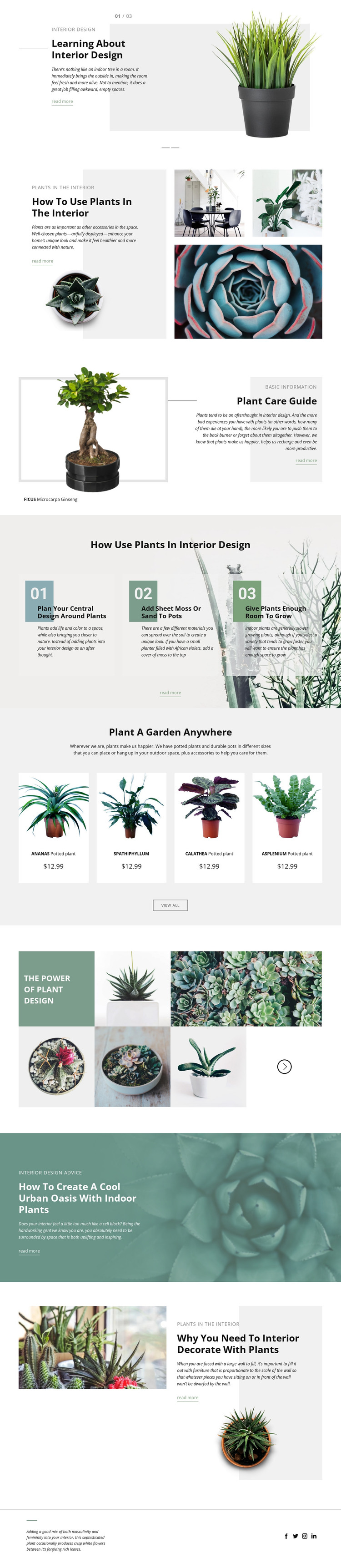
A finished editorial arrangement from plant advice to product discovery
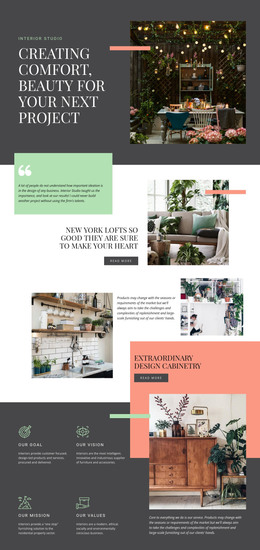
The page already assembles the main content needed for a self-contained plant and interior design presentation. It begins with a full-width article slider, where a large plant image and compact editorial panel establish the subject before visitors move into the split feature about using plants in interiors. The next section narrows the focus to a FICUS Microcarpa Ginseng specimen and its care guidance, giving the page a practical educational layer rather than relying only on decorative imagery.
The three numbered advice panels extend that teaching sequence with recommendations about planning a central design around plants, adding sheet moss or sand to pots, and allowing enough room for growth. After the advice, the four-card product showcase shifts from information to product discovery, while the botanical gallery reinforces the visual subject. A full-width urban oasis article and a closing interior decoration article return the page to editorial exploration, creating a complete rhythm of learning, viewing, and browsing. The read-more links and view-all action are already positioned as natural continuation points, and the footer adds descriptive text with Facebook, Twitter, Instagram, and LinkedIn links. Together, these areas make the design usable as a standalone static HTML page whose content feels intentionally arranged rather than assembled from unrelated blocks.
Customize with Nicepage
Open this ready-made template in the HTML Builder and customize it visually in the Nicepage editor. Replace demo content, edit page sections, and adapt the design to your project without rebuilding the template from scratch.
Export and Use This Template as an HTML Website
Create a Portable HTML Website
When the template is ready, use the HTML Export option to create a static website with the files required for deployment. The exported website can be used independently of the Nicepage editor and deployed on your preferred hosting.
Nicepage also provides SEO settings and optimization features, including Page Titles and Descriptions, Canonical settings, headings, image Alt Text, and other page-level properties that help prepare the website for search engines.
Deploy Without a CMS
Upload the finished website to the hosting environment that fits your project. Because the exported site does not require WordPress, Joomla, or another CMS to deliver its pages, it can be placed on your own server, uploaded to a hosting provider, or deployed through an existing web infrastructure.
Hand Off the Website Files
The generated website files can also be provided to a client, developer, or hosting team. They remain available outside the Nicepage editor for deployment, technical review, or project-specific development when additional work is required.
This workflow makes the template a practical foundation for a portable static website that can be exported from the Nicepage editor and deployed independently.

More from Interior HTML Templates
-
Free Website Builder SoftwareDownload