Design of future technology HTML Template


Edit Template Offline
2. Create new page and search for id 12295
Edit Template Online
Create Awesome Websites


Free Nicepage Builder
Keywords
The hero, galleries, and footer complete a static presentation
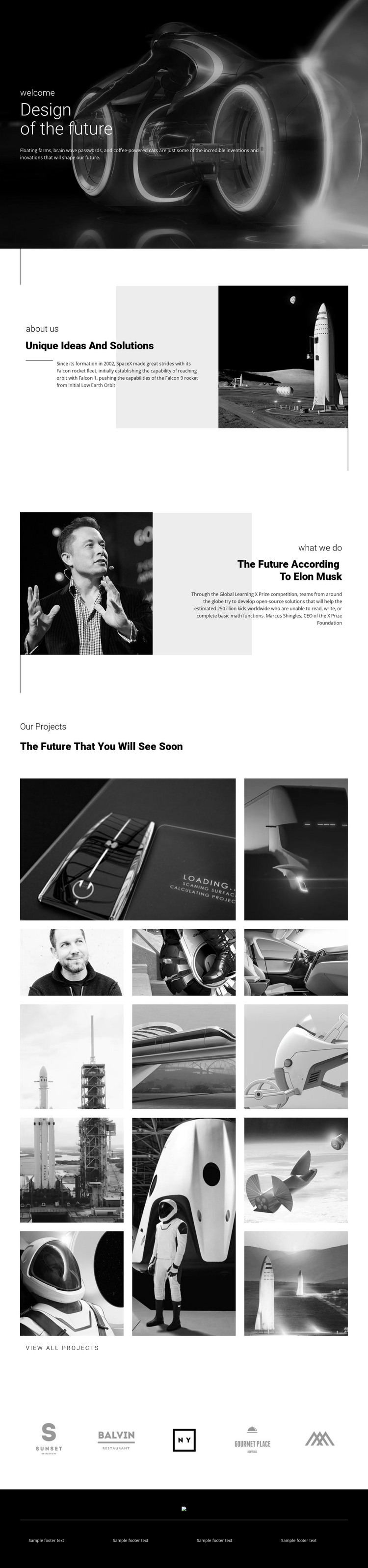
The opening hero gives the page an immediate standalone entry point: a full-width dark image carries the future-design headline and introductory copy without depending on another page to explain the subject. The following informational sections then add context in two different arrangements. Text beside a rocket image introduces unique ideas and solutions, while the portrait-led section places commentary beside a human visual reference. This progression lets the page present both an overall concept and supporting interpretation within one finished document.
The project content supplies the strongest evidence of a complete static implementation. The first gallery presents five images in an asymmetrical composition, and the second adds eight more in three vertical columns. Together, the thirteen visible project images create a substantial portfolio area rather than leaving the visitor with only a hero and short introduction. The centered “View all projects” action marks a possible next step while remaining part of the existing page presentation.
A row of five brand marks broadens the content after the galleries, and the dark footer gathers four text areas into a defined closing region. The consistent monochrome treatment, thin geometric lines, large photographic imagery, and generous white space connect these sections into one finished HTML page. The result is useful as a ready-made static implementation for presenting future-oriented concepts and projects without treating the design as only an isolated visual mockup.
Customize with Nicepage
Open this ready-made template in the HTML Builder and customize it visually in the Nicepage editor. Replace demo content, edit page sections, and adapt the design to your project without rebuilding the template from scratch.
Export and Use This Template as an HTML Website
Create a Portable HTML Website
When the template is ready, use the HTML Export option to create a static website with the files required for deployment. The exported website can be used independently of the Nicepage editor and deployed on your preferred hosting.
Nicepage also provides SEO settings and optimization features, including Page Titles and Descriptions, Canonical settings, headings, image Alt Text, and other page-level properties that help prepare the website for search engines.
Deploy Without a CMS
Upload the finished website to the hosting environment that fits your project. Because the exported site does not require WordPress, Joomla, or another CMS to deliver its pages, it can be placed on your own server, uploaded to a hosting provider, or deployed through an existing web infrastructure.
Hand Off the Website Files
The generated website files can also be provided to a client, developer, or hosting team. They remain available outside the Nicepage editor for deployment, technical review, or project-specific development when additional work is required.
This workflow makes the template a practical foundation for a portable static website that can be exported from the Nicepage editor and deployed independently.

More from Technology HTML Templates
-
Free Website Builder SoftwareDownload