Lots of photos Html Code Example


Six Image Regions Leave Room for Targeted Extensions
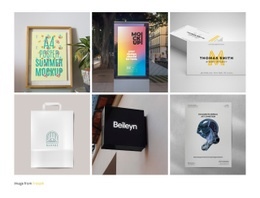
The block already establishes a complete visual relationship between six rounded gallery images and the identifying heading “2022 Image Gallery.” The asymmetrical collage supplies the image presentation, while the lower-left heading names what visitors are seeing. Business-related photographs, including people and a meeting room, provide the subject matter without requiring a slider, filter, or other control. The interaction is static, so any extension should respect that straightforward presentation rather than implying that navigation is already built in.
For an HTML Code use case, the distinct image area and heading area can act as logical extension points. A project might place custom markup beside the gallery, add data associated with individual images, or connect an external component to a relevant image region if the final requirements call for it. Such an addition would be optional and project-specific; it is not part of the existing section’s content.
Nicepage’s HTML Element can provide a way to add custom content or functionality when a real integration is needed. The existing collage should remain the visual base, with any code kept subordinate to the six-image gallery and its heading instead of turning the section into a general-purpose application area.
Customize with Nicepage
Open this ready-made template in the HTML Code Generator and customize it visually in the Nicepage editor. Replace demo content, edit page sections, and adapt the design to your project without rebuilding the template from scratch.
Edit Template Offline
2. Create a new page or select existing
3. Click Add new block, search for id 2749043 and click enter
Edit Template Online
Create Awesome Websites


Free Nicepage Builder
Keywords
Extend This Block With Custom HTML Code
Add Custom Code Inside or Beside the Section
Use the HTML Element when the block needs project-specific content or functionality that is not provided by its existing elements. The custom element can be placed within the section or near a relevant content region so the added functionality remains connected to the block's purpose.
Position the HTML Element in the Layout
Treat the HTML Element as part of the visual composition. Adjust its position, width, height, alignment, and margins so the custom content fits alongside the block's text, images, buttons, cards, or other elements instead of behaving like a separate page.
Add HTML, CSS, JavaScript, or External Components
The HTML Element supports HTML, CSS, and JavaScript and can be used for custom code and third-party components, including widgets, feeds, advertising code, or other integrations required by a project. Use these capabilities only when the section needs functionality beyond its verified built-in content.
This workflow keeps the original block as the visual/content base while providing a controlled way to extend one section without turning custom code into the primary structure of the whole page.