Visit us or call today HTML5 Template


The Heading, Information Column, Image, and Form Form a Clear Hierarchy
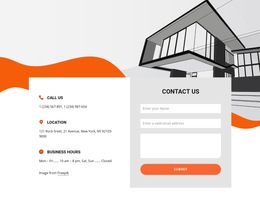
The block’s internal hierarchy begins with the centered heading “Visit us or call us today.” Its bold emphasis on part of the title establishes the section’s subject before visitors reach the content row. Beneath that introduction, the row is divided into three related groups rather than treated as one undifferentiated area.
The left group contains the Opening Hours heading, practical schedule text, and an email contact link. The center group is reserved for a monochrome architectural image, creating a visual pause between contact information and response fields. The right group contains the name, email, and message inputs followed by the Submit control. This ordering gives the form its own functional region while keeping it connected to the visit details.
As an HTML5-oriented section, the useful design question is how these groups relate inside the block. The heading introduces the purpose, the left column supplies context, the image provides visual separation, and the right column supports a message action. The dark blue background unifies the structure, while white typography and high-contrast fields distinguish text from form controls. In a larger page, this internal organization lets the section retain a recognizable contact role without requiring unrelated page-level elements inside it.
Customize with Nicepage
Open this ready-made template in the HTML5 Template Builder and customize it visually in the Nicepage editor. Replace demo content, edit page sections, and adapt the design to your project without rebuilding the template from scratch.
Edit Template Offline
2. Create a new page or select existing
3. Click Add new block, search for id 63924 and click enter
Edit Template Online
Create Awesome Websites


Free Nicepage Builder
Keywords
Explore the Structure of This HTML5 Block
Inspect the Block Hierarchy
Use the Layers panel to inspect the hierarchy of the block, including its Containers, Elements, repeated content groups, and nested items. For a reusable section, the useful structural question is how the content inside the block is organized, not how an entire website is arranged from Header to Footer.
Work With Organized Content Groups
A block can combine headings, text, images, buttons, grids, lists, forms, or other elements inside one structured section. Keeping those relationships visible makes it easier to select, rename, hide, lock, or reorganize parts of a more complex layout without losing the intended content hierarchy.
Extend the Structure Carefully
If a project later needs an extra content element or custom integration, the internal hierarchy can be inspected before changes are made. This helps preserve the relationship between the block's existing elements while the section is adapted to the needs of the containing page.
This workflow treats the design as an HTML5-oriented section with a clear internal organization, while page-level navigation, Header, Footer, and other site structure remain outside the block unless they are explicitly part of the section itself.