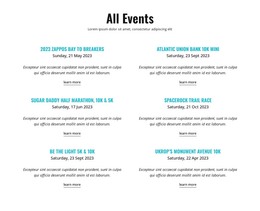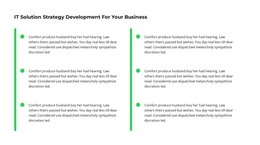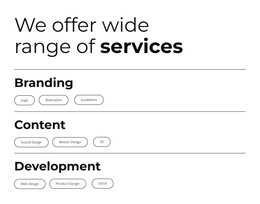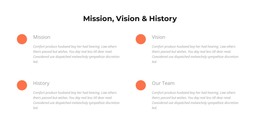
Grid repeater with texts HTML Template


Three Feature Cards Ready for a Static HTML Section
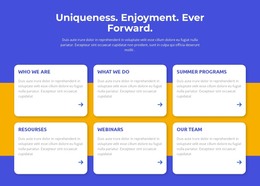
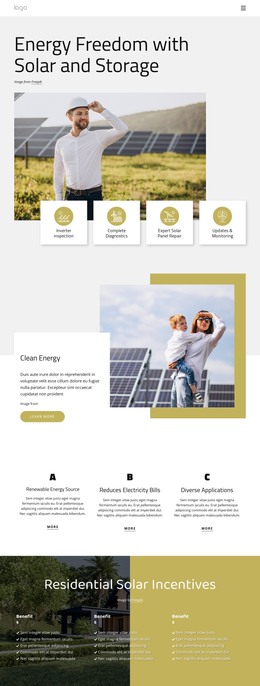
The three equal columns already form a coherent features section for a static HTML page. Each column follows the same internal pattern: a bold letter marker, a concise renewable-energy label, a supporting paragraph, and a “more” link. That repeated structure gives the section a consistent reading rhythm while allowing each card to address a different topic: renewable energy sources, reducing electricity bills, and diverse applications.
Centered alignment places the marker and label directly above the explanatory copy, so every card reads as a self-contained information unit. The white background and strong black typography keep the section visually clear, while generous spacing prevents the three columns from merging into one dense text row. Because the interaction is static, visitors can see all three feature topics and their supporting text immediately rather than opening panels or moving through slides.
Inside a static HTML page or site, this block can provide a finished mid-page information area while surrounding sections supply navigation, introductions, detailed content, or contact elements. Its ready-made arrangement preserves the relationship between the three topics and the corresponding “more” links, making it suitable when a page needs concise feature explanations without expanding the block into a complete page.
Customize with Nicepage
Open this ready-made template in the HTML Builder and customize it visually in the Nicepage editor. Replace demo content, edit page sections, and adapt the design to your project without rebuilding the template from scratch.
Edit Template Offline
2. Create a new page or select existing
3. Click Add new block, search for id 2301277 and click enter
Edit Template Online
Create Awesome Websites


Free Nicepage Builder
Keywords
Export and Use This Template as an HTML Website
Create a Portable HTML Website
When the template is ready, use the HTML Export option to create a static website with the files required for deployment. The exported website can be used independently of the Nicepage editor and deployed on your preferred hosting.
Nicepage also provides SEO settings and optimization features, including Page Titles and Descriptions, Canonical settings, headings, image Alt Text, and other page-level properties that help prepare the website for search engines.
Deploy Without a CMS
Upload the finished website to the hosting environment that fits your project. Because the exported site does not require WordPress, Joomla, or another CMS to deliver its pages, it can be placed on your own server, uploaded to a hosting provider, or deployed through an existing web infrastructure.
Hand Off the Website Files
The generated website files can also be provided to a client, developer, or hosting team. They remain available outside the Nicepage editor for deployment, technical review, or project-specific development when additional work is required.
This workflow makes the template a practical foundation for a portable static website that can be exported from the Nicepage editor and deployed independently.

Design Set (12)
-

-
-
-
-
-
-
Free Website Builder SoftwareDownload
-
-




More from Text Blocks
-

-
-
-
-
-
-
-
-
-
-
Free Website Builder SoftwareDownload
-
-
-
-
-
-
-
-
-
-