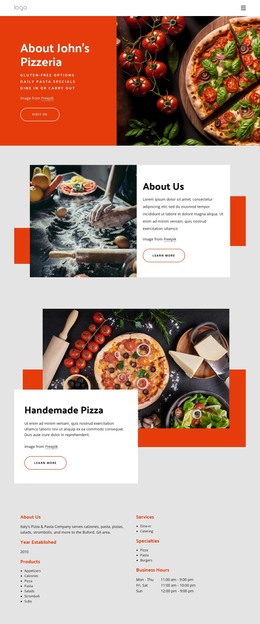
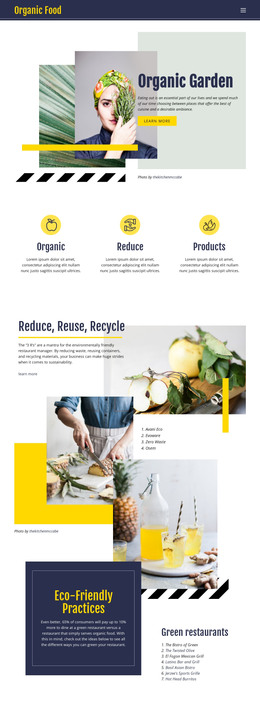
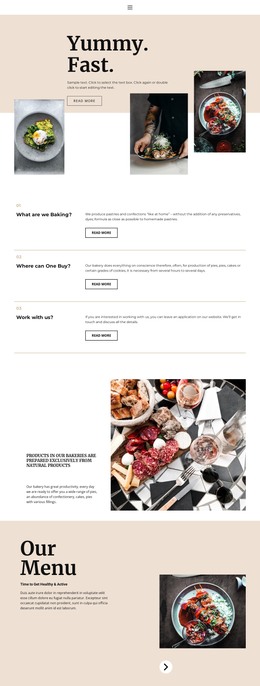
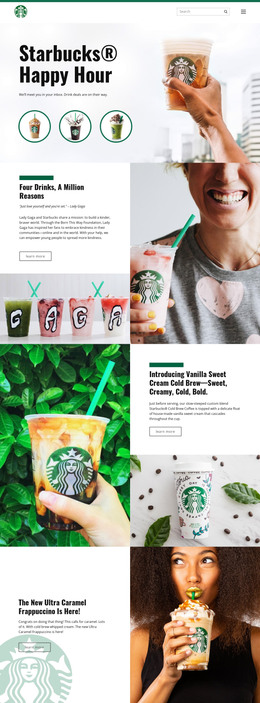
Healthy menu HTML Template
Edit Template Offline
2. Create new page and search for id 17886
Edit Template Online
Create Awesome Websites


Free Nicepage Builder
Keywords
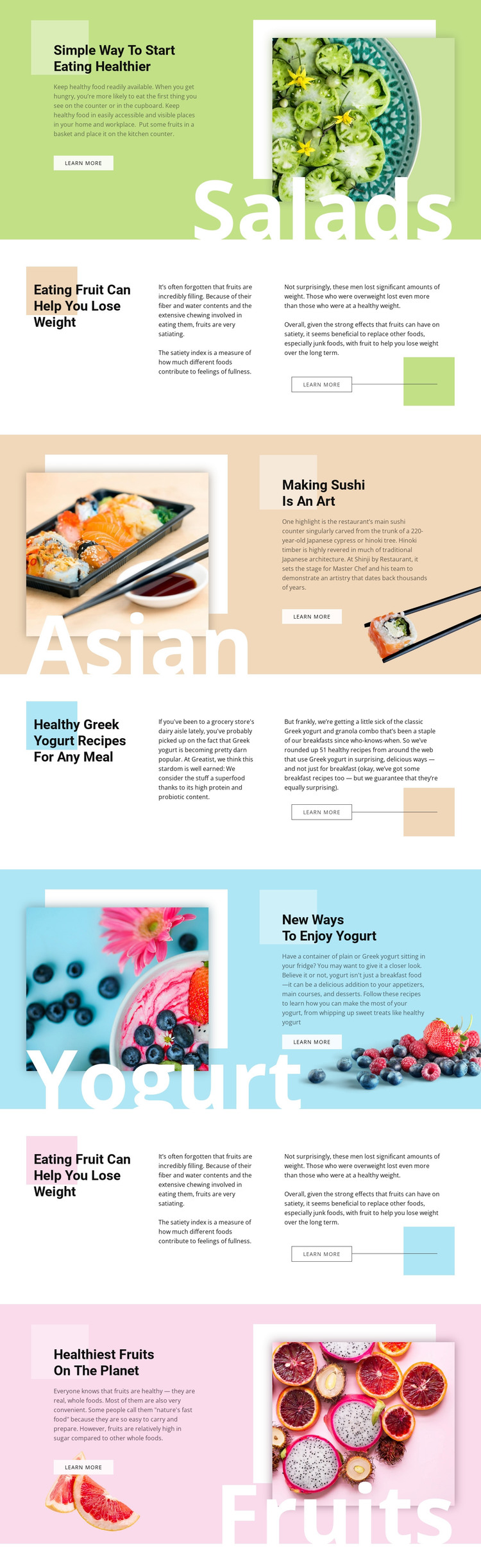
Seven Food Stories Form a Complete Static Page Arrangement
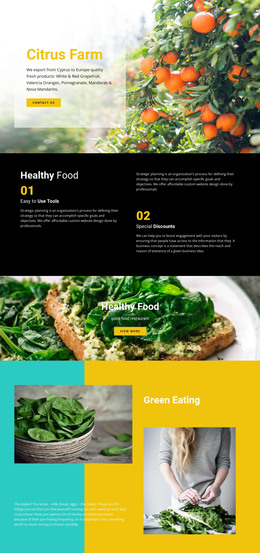
The page already brings together the main content pieces expected in a self-contained food editorial presentation. It opens with a salad feature and then alternates between image-led topics and more expansive Split sections. Fruit guidance, sushi culture, Greek yogurt recipes, new ways to enjoy yogurt, and healthiest-fruit content provide enough subject variety to make the page feel like a curated collection rather than a single isolated article.
Each image-led section combines food photography, a large category label, introductory text, and a Learn more action. The Split sections change the reading pace by placing a strong heading beside two explanatory passages and a lower action link. This alternation gives the static arrangement both visual entry points and areas for longer copy, while the recurring food themes keep the page coherent. The pastel backgrounds and generous spacing support separation between stories without requiring a different layout for every topic.
As an HTML template, the design is useful because its content relationship is already understandable: a visitor encounters a featured subject, receives a short editorial introduction, and can continue to related material. The page therefore works as a complete static implementation concept, while its demo wording and imagery can be replaced with verified content for the final project.
Customize with Nicepage
Open this ready-made template in the HTML Builder and customize it visually in the Nicepage editor. Replace demo content, edit page sections, and adapt the design to your project without rebuilding the template from scratch.
Export and Use This Template as an HTML Website
Create a Portable HTML Website
When the template is ready, use the HTML Export option to create a static website with the files required for deployment. The exported website can be used independently of the Nicepage editor and deployed on your preferred hosting.
Nicepage also provides SEO settings and optimization features, including Page Titles and Descriptions, Canonical settings, headings, image Alt Text, and other page-level properties that help prepare the website for search engines.
Deploy Without a CMS
Upload the finished website to the hosting environment that fits your project. Because the exported site does not require WordPress, Joomla, or another CMS to deliver its pages, it can be placed on your own server, uploaded to a hosting provider, or deployed through an existing web infrastructure.
Hand Off the Website Files
The generated website files can also be provided to a client, developer, or hosting team. They remain available outside the Nicepage editor for deployment, technical review, or project-specific development when additional work is required.
This workflow makes the template a practical foundation for a portable static website that can be exported from the Nicepage editor and deployed independently.

More from Food & Restaurant HTML Templates
-
Free Website Builder SoftwareDownload