Ice cream cakes HTML Template


Three food categories form a ready-made static section
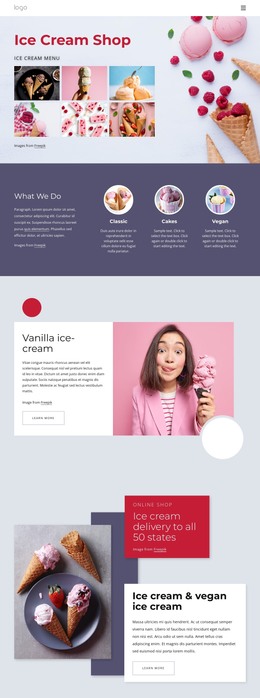
The “What We Do” heading and introductory paragraph establish the purpose of the section before the repeated category row begins. On the right, Classic, Cakes, and Vegan are presented as three distinct food categories, each combining a circular photograph with a title and descriptive text. Together, these elements provide a self-contained way to introduce several offerings without requiring the surrounding page to supply the section’s basic content structure.
The split layout also gives the section a clear reading relationship. The left column provides general context, while the three category items supply specific examples. A solid deep red background contains both areas, and white typography and image borders keep the arrangement visually connected. The circular frames distinguish the photographs from the text while preserving a repeated pattern across all three items. Generous horizontal spacing helps the introductory column and category row remain separate rather than collapsing into one dense group.
Used as an HTML Template, this block can be placed as one finished static section inside an HTML page or site. The surrounding project can provide navigation, additional sections, and other page-level content, while this block continues to carry its focused food-category role. Its sample wording and images can be replaced with project content without changing the underlying split arrangement or the relationship between the introduction and the three offerings.
Customize with Nicepage
Open this ready-made template in the HTML Builder and customize it visually in the Nicepage editor. Replace demo content, edit page sections, and adapt the design to your project without rebuilding the template from scratch.
Edit Template Offline
2. Create a new page or select existing
3. Click Add new block, search for id 1443422 and click enter
Edit Template Online
Create Awesome Websites


Free Nicepage Builder
Keywords
Export and Use This Template as an HTML Website
Create a Portable HTML Website
When the template is ready, use the HTML Export option to create a static website with the files required for deployment. The exported website can be used independently of the Nicepage editor and deployed on your preferred hosting.
Nicepage also provides SEO settings and optimization features, including Page Titles and Descriptions, Canonical settings, headings, image Alt Text, and other page-level properties that help prepare the website for search engines.
Deploy Without a CMS
Upload the finished website to the hosting environment that fits your project. Because the exported site does not require WordPress, Joomla, or another CMS to deliver its pages, it can be placed on your own server, uploaded to a hosting provider, or deployed through an existing web infrastructure.
Hand Off the Website Files
The generated website files can also be provided to a client, developer, or hosting team. They remain available outside the Nicepage editor for deployment, technical review, or project-specific development when additional work is required.
This workflow makes the template a practical foundation for a portable static website that can be exported from the Nicepage editor and deployed independently.