Text and logotype Html Code Example


The Paragraph and Logo Grid Define Clear Extension Areas
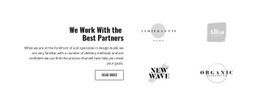
The left text column already establishes the block’s message through the “Wedding Planner Team” heading and one supporting paragraph. The right side then provides a separate visual region containing six monochrome logos in two rows of three. Because these areas are clearly bounded, custom HTML can be considered around a specific content region if a project later needs functionality that the existing static arrangement does not provide.
For example, an external directory, partner-data display, or project-specific integration could be positioned near the logo collection without replacing the introductory text. The logo grid supplies a stable visual frame, while the paragraph remains the explanatory anchor for the section. Any added element would need to respect the existing horizontal balance, the generous spacing around each mark, and the warm off-white background so that custom content does not overpower the six-logo arrangement.
This HTML Code angle concerns optional extension, not code already contained in the block. The underlying section remains static: one heading, one paragraph, and six logo images. Custom markup or an external component would be an additional project decision, useful only when the surrounding website needs behavior or data beyond the brands presentation.
Customize with Nicepage
Open this ready-made template in the HTML Code Generator and customize it visually in the Nicepage editor. Replace demo content, edit page sections, and adapt the design to your project without rebuilding the template from scratch.
Edit Template Offline
2. Create a new page or select existing
3. Click Add new block, search for id 41729 and click enter
Edit Template Online
Create Awesome Websites


Free Nicepage Builder
Keywords
Extend This Block With Custom HTML Code
Add Custom Code Inside or Beside the Section
Use the HTML Element when the block needs project-specific content or functionality that is not provided by its existing elements. The custom element can be placed within the section or near a relevant content region so the added functionality remains connected to the block's purpose.
Position the HTML Element in the Layout
Treat the HTML Element as part of the visual composition. Adjust its position, width, height, alignment, and margins so the custom content fits alongside the block's text, images, buttons, cards, or other elements instead of behaving like a separate page.
Add HTML, CSS, JavaScript, or External Components
The HTML Element supports HTML, CSS, and JavaScript and can be used for custom code and third-party components, including widgets, feeds, advertising code, or other integrations required by a project. Use these capabilities only when the section needs functionality beyond its verified built-in content.
This workflow keeps the original block as the visual/content base while providing a controlled way to extend one section without turning custom code into the primary structure of the whole page.