Beauty Salon Html Code Example


Edit Template Offline
2. Create new page and search for id 23509
Edit Template Online
Create Awesome Websites


Free Nicepage Builder
Keywords
Treatment Sections Leave Clear Extension Points
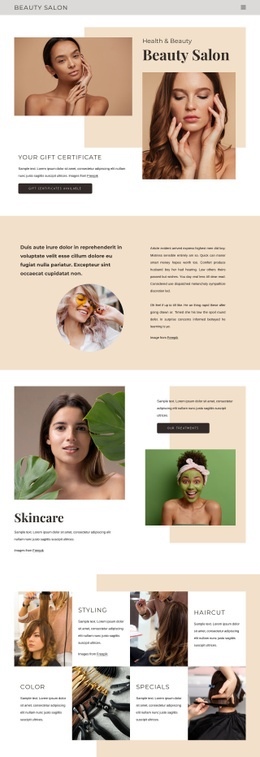
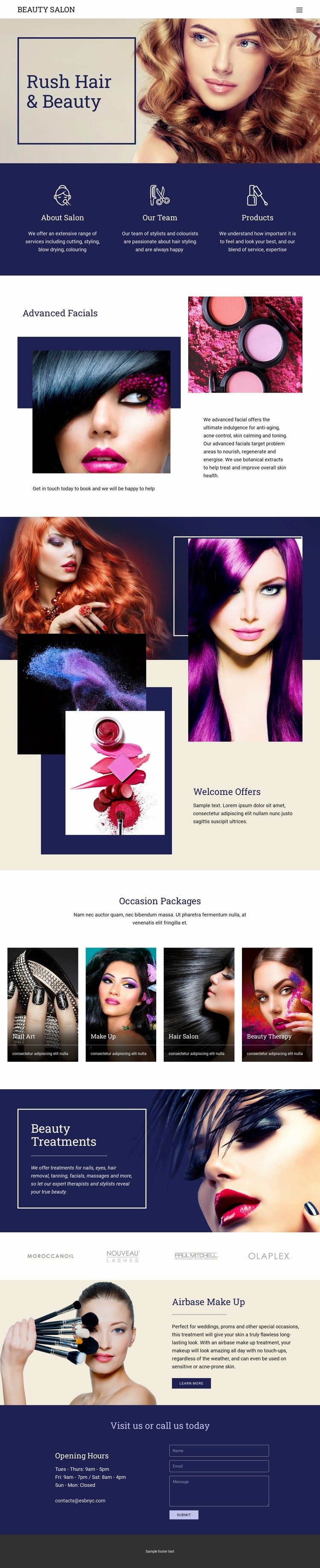
The page already separates its main content into useful zones for any project-specific additions. The Advanced Facials section combines several images with treatment information and a booking prompt, while the Hair Treatments and Beauty Treatments panels provide more focused service descriptions beside large photographs. These areas could accommodate an external treatment selector, a booking widget, or another custom component if the final project requires functionality beyond the standard content blocks.
The four Occasion Packages cards create a second type of integration point. Nail Art, Make Up, Hair Salon, and Beauty Therapy are presented as distinct visual categories, so an added component could be associated with one category without disrupting the page-wide hierarchy. The Airbase Make Up section similarly pairs descriptive copy with a small action link, leaving a natural place for an expanded occasion-related interaction. The closing contact area is different again: it combines opening hours, email contact, and a form, making it the clearest location for a project-specific enquiry or scheduling connection.
These possibilities concern future extensions, not code already present in the template. The existing imagery, cards, navigation, and form should remain the visual framework, while custom HTML, CSS, JavaScript, or an external component can be introduced beside the section whose purpose it supports. That approach adds functionality without replacing the salon’s established presentation.
Customize with Nicepage
Open this ready-made template in the HTML Code Generator and customize it visually in the Nicepage editor. Replace demo content, edit page sections, and adapt the design to your project without rebuilding the template from scratch.
Extend This Page With Custom HTML Code
Insert Code With the HTML Element
Use the HTML Element to add custom code directly to a Block in the Nicepage editor. Enter the required markup in the Code field when the page needs content or functionality that is not available through the standard page elements.
Place the HTML Element in the Layout
Treat the HTML Element as part of the visual page composition. Adjust its position, width, height, alignment, and margins to place the custom content where it belongs alongside text, images, buttons, and other elements. This makes it possible to combine visually edited sections with project-specific code without separating the custom element from the rest of the layout.
Add HTML, CSS, JavaScript, and External Components
The HTML Element supports HTML, CSS, and JavaScript, allowing you to extend the page with custom markup and interactive functionality. It can also be used to embed custom code and third-party components, such as social feeds, advertising code, widgets, or other external functionality required by the project.
This workflow makes the template useful for projects that need a visual page editor together with custom HTML code, JavaScript, embedded components, and functionality beyond the standard page elements.

More from Fashion & Beauty Html Code Examples
-
Customize Any TemplateDownload